

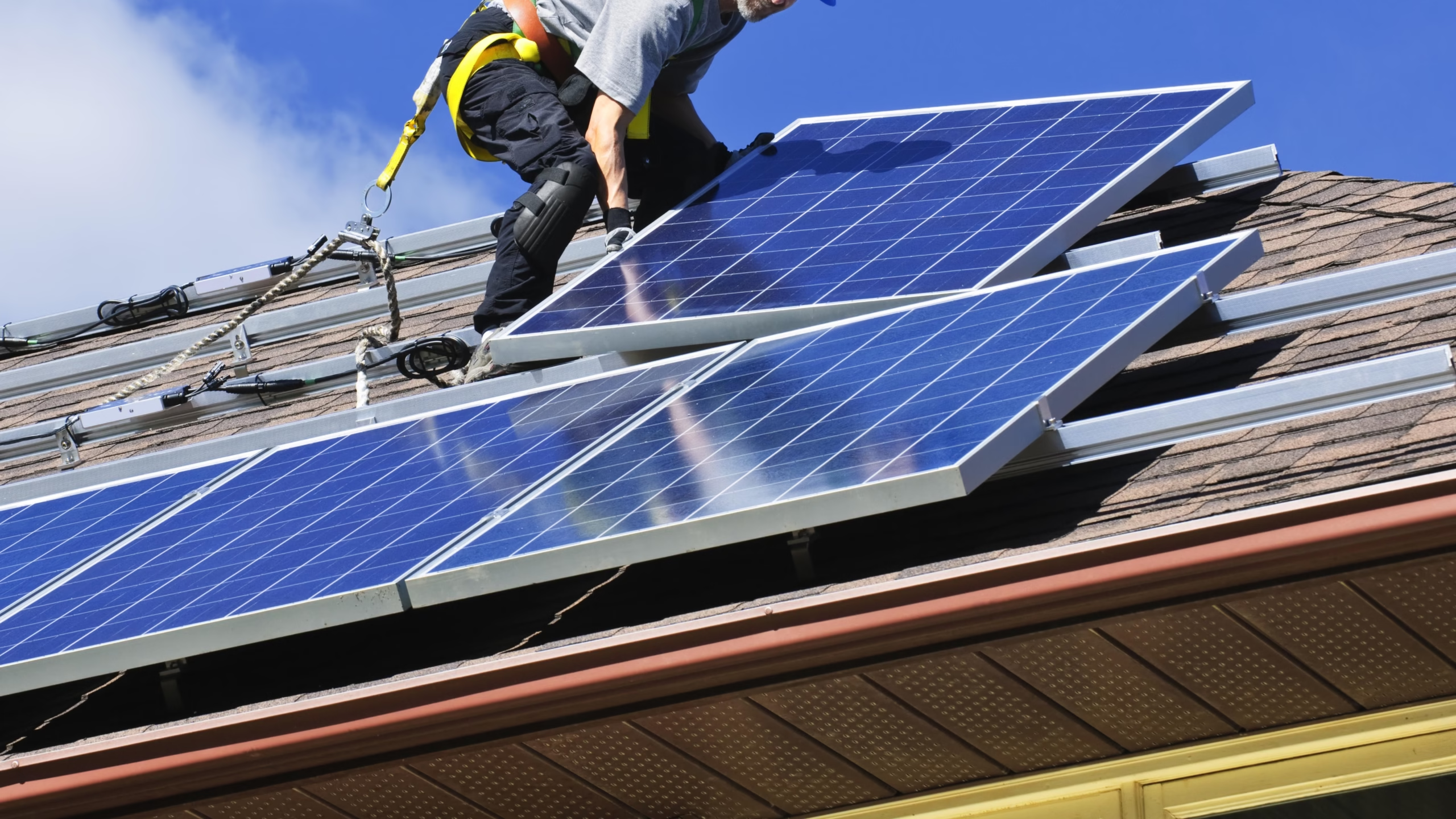
The increasing power outages in the country are making Nigerians to shift to alternate energy source, and solar is their preferred energy alternative. With two major grid collapses in January, Nigeria started 2026 with continued instability after over 16 grid collapses in 2024-2025. The first grid collapse in January 23, 2026, lasted between 12:40pm – 1:00pm, resulted in nationwide blackout.
Power generation dropped to zero MW, when all the 11 Discos -Abuja, Ikeja, Eko, Benin, Enugu, Ibadan, Jos, Kano, Kaduna, Port Harcourt, Yola, recorded 0 load. It was blamed on simultaneous ‘tripping’ of multiple 330kV transmission lines and disconnection of some generating units.
Before collapse, grid was transmitting over 4,000MW, with Abuja Disco receiving 639MW, Ikeja 630MW. The second collapse occurred on January 27, with partial system collapse, plunging large parts of country in darkness again. This was blamed on Voltage disturbance from Gombe Transmission Substation, propagated to Jebba, Kainji, Ayede substations.
Even when stable, grid hovered at 4,140MW on January 21, which is far below demand for its over 200 million population. The situation has been hinged on ageing infrastructure, transmission lines at point of collapse, gas supply constraints, poor maintenance. This has no doubt impacted on businesses, hospitals, firms, institutions, telecoms disruption, among others.
Accordingly, the economic impact of diesel generation, in the absence of electricity due to the volatility of grid supply, have made solar technology attractive. Leading the pack of the solar option is the seat of power, Aso Rock Presidential Villa, which in February, announced transition off the national grid, and would be adopting a solar-powered electricity system.
Nigeria is undergoing a rapid, bottom-up solar energy transition driven by the necessity for reliable power, with over 800 megawatts of new capacity installed in 2025. This surge, which has made Nigeria Africa’s second-largest solar market, is largely fueled by citizens and businesses abandoning the national grid for off-grid, rooftop, and solar home systems.
In 2025, Nigeria’s solar market saw a 141 percent increase in capacity in 2025, with around 96 percent of that being off-grid. Solar energy is gradually replacing generator dependency due to its high fuel costs and Solar becomes lifeline as electricity falters increasing cost of diesel and petrol. Solar is cheaper and a more reliable alternative.
As solar energy is breaking through the barrier that seemed impossible and opens the door to panels much more powerful than expected, research indicates that the celebrated hardware still leaves a lot of sunlight unused. Researchers from Kyushu University in Japan and Johannes Gutenberg University Mainz in Germany reported a lab result that pulls more energy carriers out of light than the number of photons absorbed.
Their setup reached about 130% quantum yield, meaning roughly one point three usable excited states were captured for every photon taken in. Associate Professor Yoichi Sasaki said, “We therefore needed an energy acceptor that selectively captures the multiplied triplet excitons after fission,” describing the bottleneck that has slowed this field for years.
In a report by ECOticias.com, the collaboration began when exchange student Adrian Sauer brought in materials long studied in his home lab, a reminder that science can move forward through unexpected connections. A classic solar cell is built around a single junction inside a semiconductor, which is the part that separates charges so electricity can flow, the report published in the Journal of the American Chemical Society, revealed.
It stated that in 1961, William Shockley and Hans Queisser laid out a theoretical ceiling for that kind of design, showing how fundamental losses keep an ideal single junction from turning all sunlight into power. “Under their assumptions, the best possible efficiency worked out to about 30%, even before you add real-world imperfections”, the report stated.
Accordingly, low-energy infrared photons usually cannot push an electron into motion, while higher-energy photons shed their extra energy as heat after the useful part is taken. That waste helps explain why a roof needs a lot of panel area to make a serious dent in an electric bill. It stated that when light lands on certain materials, it can create an exciton, a temporary bundle of energy shared by an electron and the “hole” it leaves behind.
In singlet fission, one highenergy exciton splits into two lower-energy triplet excitons, which can potentially become two charge carriers. If both carriers are collected, one photon can do more than one unit of electrical work.
According to the report, a 2013 report showed external quantum efficiency above 100%, meaning the device produced more than one charge carrier for some photons that hit it, and later work paired singlet fission layers with silicon in tandem setups that also crossed 100% at specific colors of light.
They often do not emit light easily, and they can vanish before a device can guide their energy into an electrical circuit, it stated. So, instead of splitting cleanly and being harvested, excitation can hop between molecules in a competing pathway, cutting multiplication short.
Chemists call this shortcut Förster resonance energy transfer, or FRET, which is a nonradiative handoff of excitation between nearby molecules. It can happen without emitting light, so it quietly drains energy away from the process you actually want.
According to the report, the new work centers on a metal complex, a molecule built around a metal atom that can be tuned like a custom tool. “In this case, molybdenum helps create a “spin-flip” emitter that can absorb and emit near-infrared light, the kind just beyond red that our eyes cannot see, after an electron flips a quantum property called spin.
“In plain language, it is designed to accept energy stored in triplet states that other materials struggle to use”, it stated. By matching energy levels across the system, the researchers steered energy toward triplet capture instead of the unwanted handoff that steals it. “That tuning is what let the multiplied excitons move into a usable excited state, rather than fading away as wasted heat”.
The tests were done with tetracene-based materials dissolved in a liquid, which makes it easier to mix molecules and watch energy move between them. It is a controlled environment, more like a chemistry beaker than a rooftop panel. It noted that a number above 100% can sound like a free lunch.
It is not, and the key is that quantum yield counts events, not total watts. Here, about 130% quantum yield means the system ended up exciting about one point three of the molybdenum complexes per photon absorbed. “Energy is still conserved because one higher energy photon can be converted into two lowerenergy excitations, so you are splitting one packet into two.
Think of it like breaking a bigger bill into two smaller ones. The theoretical ceiling for this style of multiplication can reach 200%, but real devices will be limited by imperfect transfer and material losses”, it stressed. The result is still early-stage, and the team describes it as a proof of concept rather than a finished solar cell.
Right now the measurements come from solution experiments, and the next step is solid state versions where the materials sit together in stable layers. That shift matters because real devices must survive years of sun, heat, and weather without falling apart.
But, the report indicated that the work is a reminder that solar progress is not only about better manufacturing, it is also about rewriting how light energy is handled. If that eventually translates to more watts per square foot, your electric bill could feel it.