

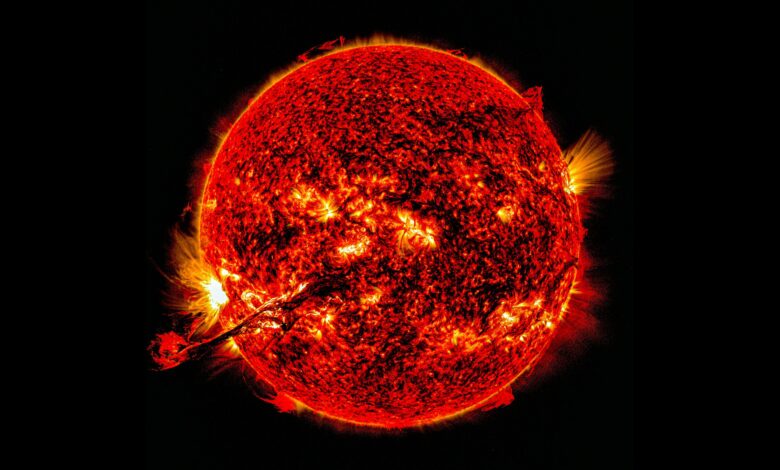
A magnetic artificial intelligence (AI) tool has been found capable to detect faint signs of emerging solar active regions about nine hours before they became visible on average. Before a sunspot darkens the sun’s visible surface, the magnetic activity that creates it is already developing out of sight. Those early changes are faint, but researchers say artificial intelligence can now recognise them hours before a new solar active region becomes visible.
The model called EarlyDetect detected signs of emerging active regions, an average of nearly nine hours ahead of their appearance. The system was developed by a New Jersey Institute of Technology (NJIT) led research team and published on August 14 in the Journal of Geophysical Research: Machine Learning and Computation. EarlyDetect searches for precursor patterns in both the sun’s acoustic activity and magnetic field, signals that scientists have previously struggled to identify reliably.
NJIT undergraduate researcher and corresponding author of the study, Jonas Tirona developed the model with computer scientists and solar physicists at NJIT and collaborators from Princeton University and NASA’s Ames Research Center. The work used observations collected by NASA’s Solar Dynamics Observatory (SDO). “The most valuable thing this work shows is that we can use machine learning to predict when solar active regions will emerge in advance.
“That early warning could allow satellite communications companies or power grid companies to prepare and potentially mitigate damage from solar storms,” said Tirona, an incoming senior computer science major and Albert Dorman Honors College scholar.
This visualisation shows the emergence of solar active region AR11158 using magnetic-field, continuum-intensity, and acoustic-power observations. A drop in acoustic power appears first, providing an early sign of emergence, followed by changes in intensity and magnetic field.
The visualisation demonstrates the data-analysis pipeline behind EarlyDetect, a machine-learning model being developed to forecast activeregion emergence. The model is not yet operational. Credit: Irina N. Kitiashvili (NASA Ames Research Center) and Spiridon Kasapis (Princeton University). Active regions are areas of intense magnetic activity where sunspots develop, with their emergence unfolding over several hours while complete development can require anywhere from one to several days.
Before those regions reach the surface, rising magnetic fields subtly alter acoustic waves moving through the sun. Scientists can study these vibrations using helioseismology, which examines waves inside the Sun to learn about processes that cannot be observed directly. EarlyDetect searches for these signals by analysing hourly maps of acoustic power together with measurements of the solar magnetic field from NASA’s Solar Dynamics Observatory.
The acoustic maps come from sound wave measurements recorded every 45 seconds by the Helioseismic and Magnetic Imager (HMI) aboard SDO. “The main difficulty is that an active region begins developing beneath the Sun’s visible surface, where we cannot directly observe the magnetic structure.