
A United States regenerative rail energy technology company, Regen Tracks, has introduced a regenerative rail energy platform that converts vibration from rail tracks in usable electricity.
The technology harvests energy continuously from track vibration, structural flex, and constant dynamic loading as trains move at full speed. Train movement creates massive dynamic weight. Every passing axle flexes the rail bed. Standard energy recovery systems mostly use regenerative braking, capturing power only when a train slows down.
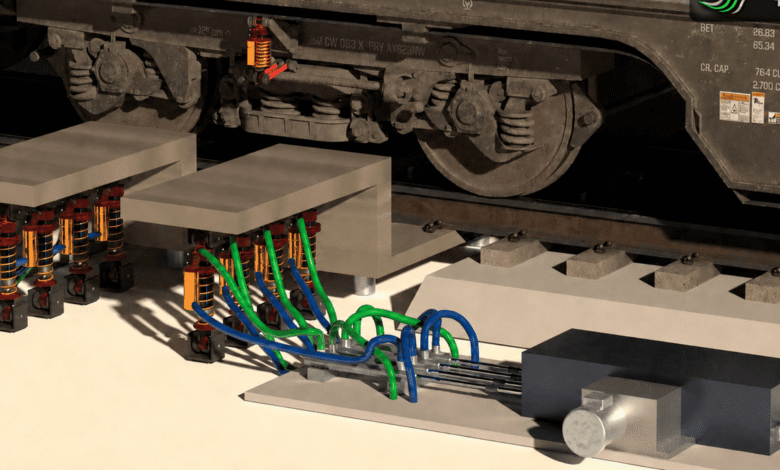
The advanced electro-hydraulic system is designed to capture mechanical energy associated with train movement and convert it into usable electrical power. Developed for modern rail environments, the Regen Tracks platform is engineered to harness dynamic load forces produced during rail operation.
The technology focuses on transforming mechanical energy that would otherwise be dissipated through rail-track vibration and movement into electrical energy for potential transportation infrastructure applications.
“We’re now capturing energy created by movement of trains, rail cars, vehicles and converting it into useful electrical output through electro-hydraulic mechanism engineered for many use cases,” said Regen Tracks spokesperson.
As rail systems experience significant mechanical forces as heavy railcars travel across track surfaces under substantial weight and momentum, Regen Tracks deploys the technology to convert the kinetic energy associated with the rail-track vibrations and repetitive dynamic loading into electricity.
The company developed a working prototype of its electro-hydraulic regenerative system to capture and process these repetitive force cycles through controlled energy-conversion mechanisms. The prototype demonstrates the underlying concept of converting rail-generated mechanical motion into electrical output.
“We’re capturing kinetic energy generated by the movement of trains, railcars, and vehicles and converting it into useful electrical output through an electro-hydraulic system engineered for a wide range of applications,” said the company spokesperson.
Unlike traditional regenerative braking systems, which primarily recover kinetic energy during deceleration, Regen Tracks’ technology is designed to capture energy from the recurring mechanical forces, vibrations, and dynamic loading associated with ongoing rail movement. The platform is being developed for potential integration alongside rail infrastructure while supporting future opportunities in energy recovery, infrastructure efficiency, and transportation innovation.
As artificial intelligence (AI) infrastructure rapidly expands worldwide, demand for reliable large-scale electricity generation continues to grow. Modern AI data centers require substantial electrical power to support high-density computing, advanced GPU processing, cooling systems, and continuous cloud operations. Regen Tracks believes future rail-based distributed energy systems could potentially contribute supplemental power by introducing additional methods of localized energy generation within transportation corridors.
Freight rail systems operate across thousands of miles of active infrastructure and move heavy loads daily through major industrial regions. Regen Tracks is exploring how regenerative rail energy systems could eventually contribute to supplemental power generation near logistics hubs, industrial zones, transportation corridors, and other energy-intensive infrastructure.
By converting mechanical energy associated with train movement into electrical energy, Regen Tracks believes rail infrastructure could potentially become part of a broader distributed energy ecosystem. Potential future applications include localized energy storage, rail infrastructure power, infrastructure energy management, grid-support opportunities, and integration with energy-intensive facilities. The company is also exploring applications of its electro-hydraulic energy-conversion technology involving railcars, vehicles, and other transportation systems.
Regen Tracks is currently focused on continued technology development, prototype refinement, engineering validation, and strategic industry positioning ahead of broader deployment. The company plans to engage with rail infrastructure partners, transportation stakeholders, engineering organizations, media, and strategic collaborators as development progresses.
The launch of the Regen Tracks brand represents a major step in establishing a dedicated identity around regenerative rail energy innovation and next-generation transportation infrastructure technologies. The company’s technology development and communications are centered on advanced engineering, energy recovery, and future-focused transportation systems.
As global transportation networks continue evolving toward greater efficiency and smarter infrastructure, Regen Tracks aims to contribute to the development of new approaches to energy recovery, distributed infrastructure power generation, and advanced rail technologies.