

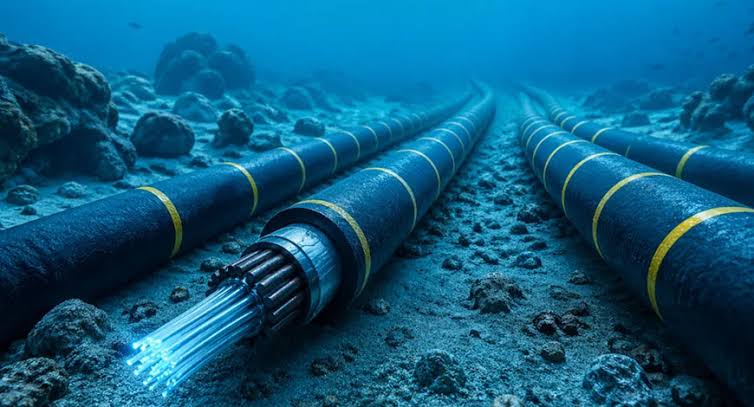
The ESA is funding the project to the tune of €1.5 million under the Space Systems for safety and Security (4S) programme, within its Advanced Research in Telecommunications Systems (ARTES) programme. CableShield will be implemented by a consortium led by Belgian multi-orbit satcom operations specialist, Nexat, Colt Technology Services Belgium, and Canadian LEO satellite company Telesat.
They reckon satellite connectivity has evolved to the point that it not only provides a backup alternative to cellular connections but even very high throughput submarine cables. “Submarine cables carry an estimated 99% of global connectivity, so when they go down, entire regions can lose access instantly, disrupting business, public services and other critical communications. “Satellite provides the lifeline that keeps essential services online when their primary connectivity is gone.
Having a dedicated multi-orbit platform like Nexat’s ensures service providers can access and manage backup connectivity effectively when it is needed the most,” said chief operations officer of Nexat, Caroline De Vos. On how a satellite possibly provide more than a tiny fraction of the traffic that goes over submarine cables, Nexat said its technology addresses this by pooling and sharing bandwidth from multiple satellite operators.
This is automated to the extent that the platform engages with the various satellite providers as much as it needs to, to provide the requisite bandwidth. This will be done through a common o r c h e s t r a t i o n framework that will address detection as well as terrestrial and satellite control layers.
A bunch of ESA standardised APIs will apparently ensure all the various moving parts communicate well with each other. Today starts an 18-month development and validation programme for CableShield, after which the commercial launch is expected. That will coincide with the commercial launch of Telesat’s L i g h t s p e e d constellation.