
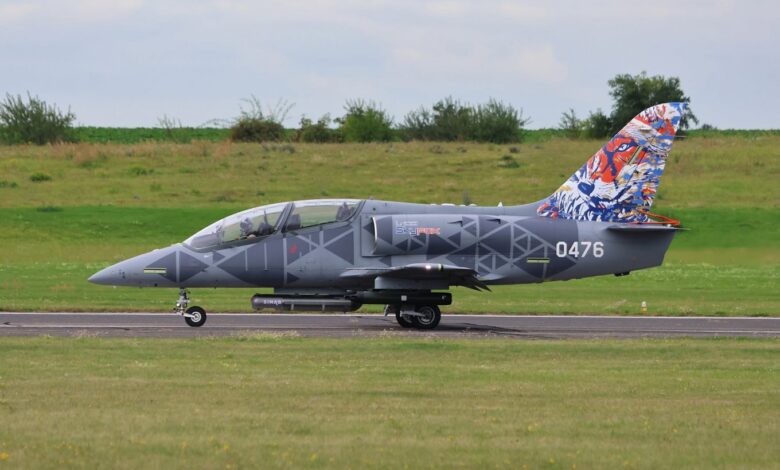
Czech defense company Aero Vodochody has demonstrated how the L-39NG Skyfox can be configured as a Drone Hunter to counter enemy unmanned aerial vehicles. The configuration was showcased at NATO Days 2026, held at Leoš Janáček Airport in Ostrava, Czechia. The bottom line is that the L-39NG Skyfox could serve as a high-tech interceptor against enemy Shahed drones, including jet-powered variants. However, there are some limitations, particularly regarding the number of UAVs it could engage during a single sortie.
According to a report by Janes and the accompanying photograph, the L-39NG Skyfox in the Drone Hunter configuration carries a Phoenix 10 targeting pod from defense company Sinab, along with two LAU-32 rocket pods, each capable of carrying seven 70 mm aerial rockets. According to the manufacturer, the Phoenix 10 pod is integrated with Link 16 and can be mounted on any jet aircraft without requiring additional upgrades. As for the LAU32 pods, it is reasonable to assume that they could also be used to launch APKWS guided rockets. The L-39NG Skyfox costs less than $10 million and can remain airborne for up to 4.5 hours.
This makes it a relatively affordable hunter of enemy UAVs, capable of engaging aerial targets with guided rockets using targeting data from an external pod. However, the first concern is the relatively small ammunition load the L-39NG can carry in the Drone Hunter configuration: just 14 guided rockets. In addition, the availability of Phoenix 10 pods could also be limited. Another question is whether the software used by these pods could be adapted to work with the situational awareness systems currently used by the Ukrainian Armed Forces.
The above should be viewed in the context that there is no perfect airborne Shahed hunter. Every solution has both advantages and disadvantages. Ivan Kyrychevskiy, serviceman of the 413th Raid Regiment of the Unmanned Systems Forces of Ukraine and weapons expert at Defense Express.