
As technology is rapidly being deployed to boost learning in the education sector, experts have expressed worry on its potential health risks among students if not used in classrooms.
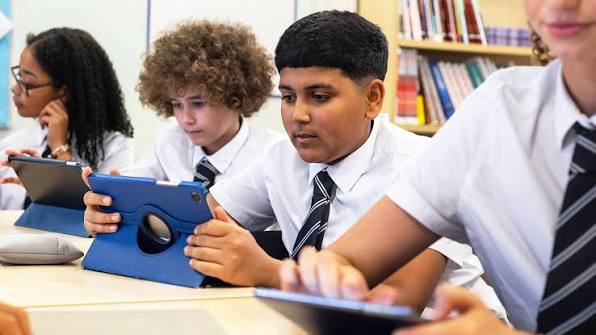
For instance, health experts in England have warned of the health danger in the amount of time children spend on screens at school, which they say could be harming their “physical and developmental health.”
While a good number of education stakeholders commend the positive impact of technology in boosting e-learning, a group of more than 150 clinicians insist that fixing the eyes on the screen longer than necessary could impact children’s mental health negatively.
General practitioners, paediatricians and other specialists said in an open letter to the UK Education Secretary Lucy Powell and Health Secretary Yvette Cooper that tablets and laptops are being used without a full understanding of their long-term health impacts, including on eye health.
The clinicians said they were prescribing glasses, hearing aids and speech therapy to children “for a problem that is unintentionally being made worse in our schools.”
The government said it was consulting on screen time guidance for children aged five to 18 but that technology could be a powerful learning tool if used properly.
The group of clinicians said nearly one million children are using screens in most lessons, despite studies suggesting a rise in short-sightedness.
They pointed to an analysis of 276 studies covering 5.4 million participants around the world. That analysis, they claimed, found a rise in short-sightedness among children and adolescents from around 24 percent in 1990 to almost 36 percent by 2023, warning the condition is associated with an increased risk of a range of eye health problems.
According to the letter, many children now spend longer time on screens in the classroom than is recommended in a 24-hour period.
“As a country, we need to wake up to this now, and start rolling back screen use in schools before the damage compounds further,” the letter said.
One of its signatories, Dr Becky Foljambe, an NHS GP and founder of Health Professionals for Safer Screens, told BBC Radio 4’s Today programme that parents had not been given the chance to “opt out” of the “excessive” use of screens in schools, which risks children “just not thriving” in education.
She said an “explosion” in short-sightedness “cannot be put down to genetics alone”.
Foljambe said it was a “lazy argument” to advocate for screen use to prepare children for a digital world, adding that “they also need their sleep, their eyesight, they need rest, they need ability to critically think and appraise.
“We are conscious that some of this evidence is still surfacing but the direction of travel is consistent across multiple, independent, and in some cases very large, bodies of research,” the letter continued.
It also warned that children with special educational needs are “disproportionately” directed to screen-based learning.
General secretary of the Association of School and College Leaders, Pepe Di’Iasio said education technology can provide schools with “very effective learning tools.” But he said such technology was only part of an “overall learning strategy,” which also includes classroom discussion and interaction, and that the school day also has “plenty of non-screen time such as PE, sport, and break times with classmates.”
“We would welcome the development of practical, evidence-based guidance to support the work of schools in the use of education technology,” he added.
Also, general secretary of the National Association of Head Teachers, Paul Whiteman said it was “important that a healthy balance is struck,” in use of gadgets, adding that “greater clarity is needed from the government on this.”
A Department for Education spokesperson said the government was developing new screen-time guidance for children aged five to 18, and will consult on the safety of artificial intelligence and educational technology in schools. They said: “Used well, technology can be a powerful tool to support learners who need it and free up teachers to deliver the excellent education every child deserves.”
It comes after a ban on smartphones in schools in England came into force in June, making individual schools and trusts legally responsible for being phone-free throughout the day.