

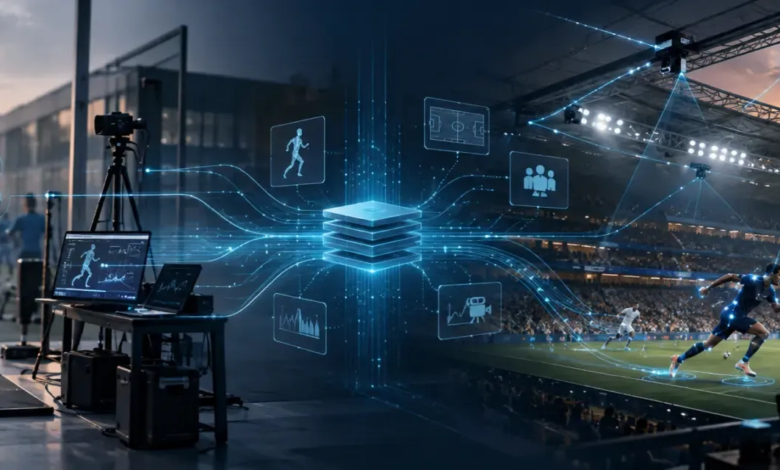
(1) Technology convergence became the standard
It identified that sports organizations increasingly want unified workflows across wearables, tracking, video, and third party systems. When technology stays fragmented, coaches and performance staff lose time to exports, reconciliation, and manual coordination instead of acting on insight. When performance is connected to competition workflows, the result is a more consistent operational layer that teams and leagues can scale across training, matches, and the season.
(2) Real-time became the baseline expectation Another point it indicated is that realtime has moved from a competitive advantage to a minimum requirement. Training windows are short, schedules are dense, and staff resources are limited. Insight that arrives too late cannot influence the session, the match, or the next decision.
(3) Movement intelligence scaled across performance environments
It also noted that performance monitoring is evolving beyond volume metrics. In 2026, more teams want a clearer understanding of how athletes move, how intensity accumulates, and how repeated high intensity actions impact performance and availability. This shift is supported by the broader adoption of wearable monitoring and accelerometer-based insights across sports. As movement understanding becomes more scalable, the focus moves toward practical insight that supports training decisions, readiness conversations, and return to play processes.
(4) Leagues expected one implementation to unlock multiple outcomes
According to the report, leagues are increasingly adopting infrastructure that supports more than one use case. Integrity requirements and media expectations are converging on the same foundation: accurate real-time sport reality. Officiating decisions are under constant scrutiny, and leagues are moving toward technology supported workflows to improve consistency, speed, and transparency. Football provides a clear signal of this direction, with semi-automated offside technology introduced at the highest levels of the game. At the same time, the same foundation enables clearer storytelling through overlays and explainable moments that improve how fans experience the game.
(5) Adoption became the real competitive advantage
It also identified that the strongest technology is not the one with the longest feature list. It is the one that gets used every day. Organizations have learned that tools alone do not create impact. Workflows do. If a system is too fragile or too complex, it stays in the background. If it becomes part of daily decision making, it creates an advantage.