

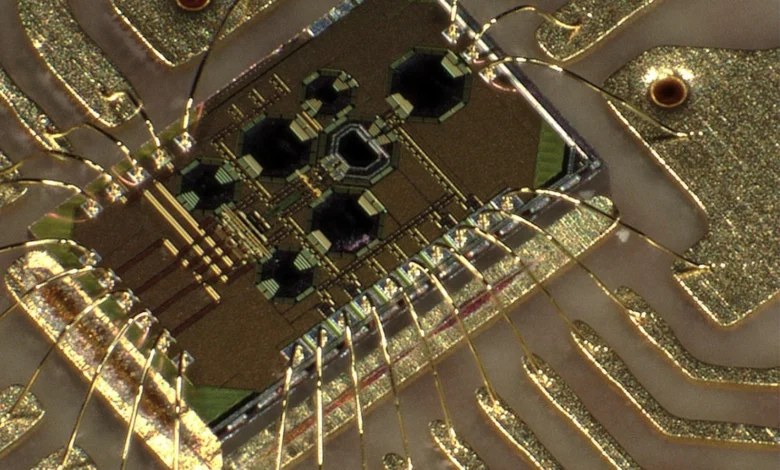
Researchers at the Institute of Science, Tokyo, have developed a 2.4 gigahertz Wi-Fi receiver chip capable of surviving radiation doses of up to 500 kilograys (kGy), a level that would quickly disable conventional electronics. The breakthrough could significantly improve robotic operations inside damaged nuclear facilities such as Fukushima Daiichi Nuclear Power Plant.
The innovation addresses one of the most persistent challenges in nuclear decommissioning — cabling. At heavily contaminated sites, remotely operated robots are typically connected to operators through thick LAN cables. While these tethers provide reliable communication, they also create major logistical problems. Cables can snag on sharp debris, become entangled in confined spaces, or snap under strain.
They also restrict mobility and limit how many robots can operate simultaneously in hazardous zones. The newly developed radiation-hardened Wi-Fi chip could eliminate those constraints by enabling stable wireless communication in environments saturated with intense gamma radiation. “Such tolerance addresses the requirements of nuclear power plant decommissioning, which involves exposure to intense gamma radiation emitted from fuel debris,” said Atsushi Shirane, associate professor at the Institute of Science, Tokyo.
According to Shirane, introducing a wireless system would remove the need for complex cabling and allow multiple robots and drones to work together more efficiently. This could speed up cleanup operations while reducing radiation exposure risks for human workers supervising the missions. Radiation poses a severe threat to semiconductor devices.
High-energy gamma rays can penetrate chips and disrupt their internal structure by trapping electrical charges in the insulating layers of transistors. Over time, this leads to leakage currents — unintended flows of electricity that interfere with signals, degrade performance and eventually cause system failure. Rather than relying on heavy shielding, the research team focused on simplifying the chip’s internal architecture.
The engineers reduced the number of transistors in the receiver, minimising the surface area vulnerable to charge buildup and leakage. Radiation-sensitive active transistors in critical sections, including the variablegain and radio-frequency amplifiers, were replaced with inductors, passive components that remain stable under intense radiation exposure.