German Company Emerges First In Europe To Launch Fully Commercial Orbital Rocket

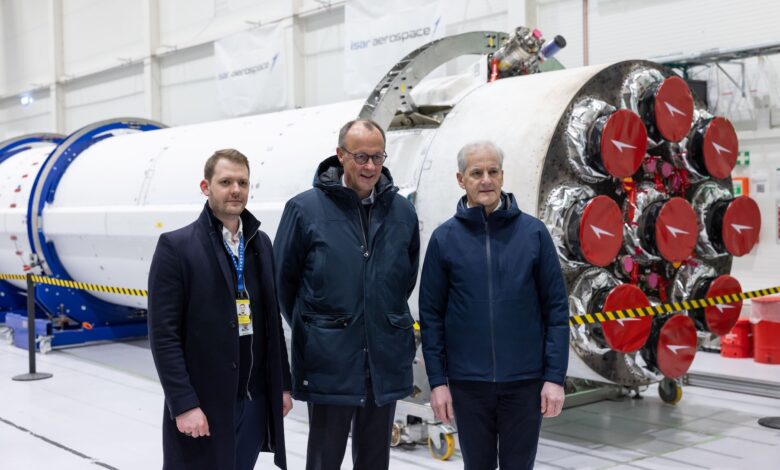
German aerospace company, Isar Aerospace, has launched a privately-developed rocket into low-Earth orbit Saturday from a Norwegian spaceport inside the Arctic Circle.
The company, founded in 2018 by three students at a German university, launched the two-stage rocket named Spectrum, becoming the first fully commercial launch vehicle in Europe to reach orbit.
With the last Saturday’s success, Isar is the clear leader among a pack of several European launch startups vying to inject some competition into Europe’s stagnant launch market.
Isar’s 92-foot-tall (28-meter) Spectrum rocket lifted off at 4:12 pm EST (20:12 UTC) Saturday from Andøya Spaceport in northern Norway, where it was 10:12 pm local time as the final bluish hues of daylight faded from the late summer sky. Seven minutes later, the rocket was in orbit.
“Today, Isar Aerospace opened space from continental Europe. Launch continues to be the largest bottleneck for the global space industry and from today on, there is a true alternative for commercial and institutional customers.
“We achieved within a few years what had taken the European space industry decades before.
“Europe now has sovereign access to space. We have entered into a new chapter for European spaceflight. I am incredibly proud of our team, that has made this success story from Europe possible. We will now focus on rapidly scaling launch vehicle production, deliver on our order pipeline, and meet surging global demand,” the company’s co-founder and chief executive, Daniel Metzler said in a press release.
Metzler joined two classmates at the Technical University of Munich in 2018 to establish Isar, named for the river that runs through the Bavarian capital. Metzler, Josef Fleischmann, and Markus Brandl enjoyed tinkering with rocket parts in a campus workshop before deciding they might be able to make some money with their hobby.
It wasn’t easy. Europe boasts a robust space sector with an impressive pedigree, but the industry is not known for its dynamism.
“Especially early on, back in 2018, when, frankly, there was no ‘New Space’ industry, especially on this side of the Atlantic, people said it will never work.
“People will continue to always say this will not work, and that will not work, until we just prove them wrong. Giving up is not in our DNA,” Metzler told reporters in a press briefing on Sunday.
It took eight years for Isar to get to orbit, a timetable similar to other successful commercial rocket startups in the West. In that time, the company raised roughly $1 billion through several private financing rounds, and now has a workforce of nearly 500 employees. This makes Isar, by far, the most well-capitalised private launch company in Europe.
“Generally, I think you very much overestimate what you can do in the short term, but I think you underestimate what you can do in the long term.
“Don’t forget the human element behind all of this. There are engineers, technicians, operators, a strong support team, who just dare to dream, and against all odds, that team delivered,” Metzler said.
Isar’s success is welcome news for the European Space Agency and Europe’s space industry as they seek lower-cost rockets to put their satellites into orbit. Europe’s incumbent launch providers, Arianespace and Avio, have relied upon billions of euros in funding from European governments to get their rockets off the ground. Those companies currently operate the Ariane 6 and Vega-C rockets, which have proven reliable but are only marginally competitive, even with the assistance of government subsidies.