

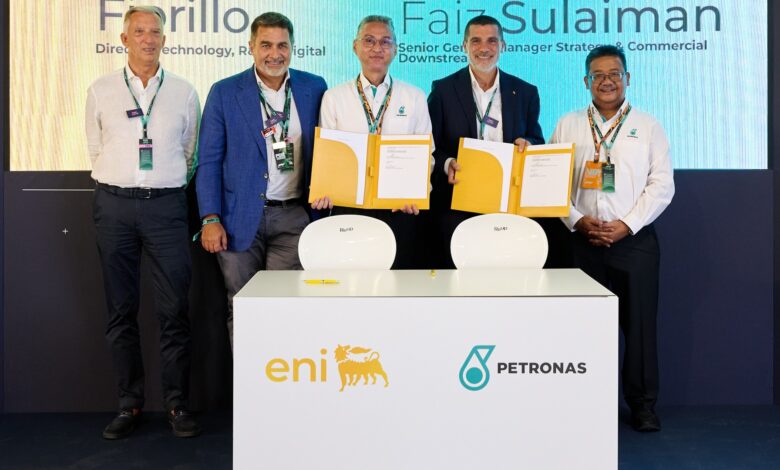
Petroliam Nasional Bhd (Petronas) and Eni SpA have signed a partnership to test newer processes to produce biofuels for high-performance deployment.
Executed on the sidelines of the Formula 1 Italian Grand Prix, the “feasibility agreement” targets potential gasolines derived from renewable raw materials that can be used in motorsports and subsequently in commercial products, Eni said in an online statement Monday.
The partners will “evaluate the development of innovative high-performance bio-gasoline starting from the established Ecofining™ technology process, through which Eni has been producing HVO [hydrotreated vegetable oil] biofuels from renewable raw materials since 2014.
“The aim of the agreement is to assess the technical, market and sustainability profiles, as well as the performance levels of new bio-gasolines.
“On one side, Eni will contribute its consolidated experience in sustainable energy solutions and in the production, at Enilive biorefineries, of commercially available biofuels from renewable feedstocks – including HVO diesel and SAF-biojet – as well as the development of innovative bio-gasoline,” Eni said.
Enilive is Eni’s biorefining and smart mobility business.
“Meanwhile, Petronas will contribute its proven expertise in fuel technology, from fossil-based fuels to high-performance sustainable fuels for combustion engines, together with its experience in sustainable energy solutions and advanced product development”.
While Italy’s Eni and Malaysia’s Petronas, both state-controlled energy majors, are partners with F1 teams Alpine and Mercedes respectively, only Petronas is an active race car fuel supplier.
The sport’s governing body, FIA, has switched to “advanced sustainable fuels” starting in the 2026 season. The switch requires power units in F1 cars to use fuels certified to have been 100 percent produced from “a renewable feedstock of non-biological origin (for example, a RFNBO), municipal waste or non-food biomass”, as stated in the new regulations published August 5, 2026 but already approved by FIA’s World Motor Sport Council four years ago.
F1 cars continue to use internal combustion engines as the new fuels are meant to replace fossil fuels without current engines having to be modified, as confirmed by F1 in clarifications published January 30, 2026.