

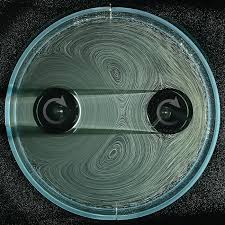
A group of researchers at New York University has developed a new type of gear system that uses fluid motion to produce rotation. This approach could pave the way for mechanical devices that are more adaptable and resilient than traditional gears, which trace their origins back to ancient China.
“We invented new types of gears that engage by spinning up fluid rather than interlocking teeth— and we discovered new capabilities for controlling the rotation speed and even direction,” says Jun Zhang, a professor of mathematics and physics at NYU and NYU Shanghai and the senior author of the paper.
Gears have been a fundamental part of machinery for thousands of years, with early examples dating to around 3,000 BCE in China, where they were used in two-wheeled chariots that traveled across the Gobi Desert. Over centuries, they have played roles in devices such as the Antikythera mechanism in ancient Greece, which predicted astronomical events, as well as in windmills, clocks, and modern robotics.
Despite their long history, traditional gears come with limitations. Their teeth, whether made of wood, metal, or plastic, are rigid and prone to damage, and they must align precisely to function correctly.
Motivated by these constraints, Zhang worked with colleagues Leif Ristroph, an associate professor of mathematics at NYU’s Courant Institute School of Mathematics, Computing, and Data Science, and Jesse Etan Smith, an NYU doctoral candidate, to explore whether gearlike behavior could be achieved without physical teeth or direct contact between components.
Because moving air and water already drive systems such as turbines, the researchers proposed that carefully controlled fluid flows could effectively take on the role of gear teeth.