
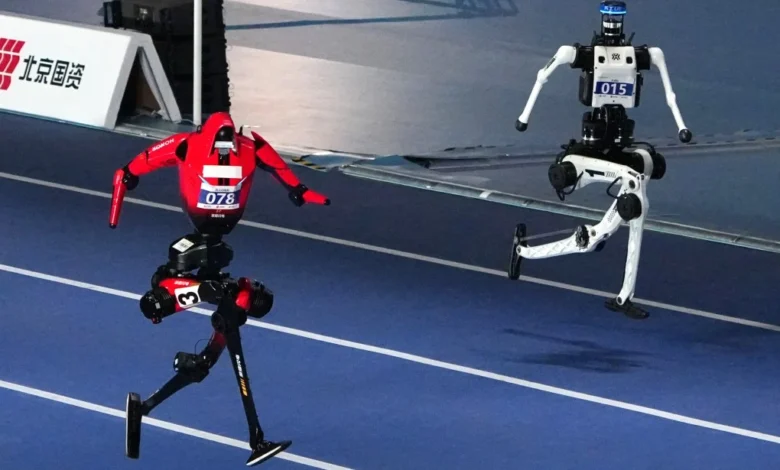
The 100-meter sprint in Beijing’s National Speed Skating Oval brought together the world’s fastest runners, hurtling along at breakneck speed to shrieks of excitement from a captivated crowd. The only difference is that, after this race, some of the competitors collapsed to the floor with sparks flying from their insides while safety officials charged over to attend to them with fire extinguishers.
Welcome to the World Humanoid Robot Games, where the marquee 100m was won in a time of 8.64 seconds (almost a second quicker than Usain Bolt’s world record of 9.58s, set in 2009) to bring to a close a five-day event that also featured boxing, soccer, tennis and weightlifting, alongside track and field. In the high jump, one ‘athlete’ leaped 2.88m – 43cm higher than Javier Sotomayor’s world record of 2.45m.
The 2026 edition, held from August 22 to 26, was a step up in quantity and quality from the inaugural Games last year. It saw 2,056 robots from 16 countries across six continents competing — quadruple the number involved in that first event, according to China’s national broadcaster CCTV.
Why, though? Why would Chinese companies invest so much money and time into creating robots that perform such athletic feats (and crash and burn afterwards)?
“I think they want to impress us with the physical capabilities of the machines,” says Amit Katwala, a sports technology writer and author of The Athletic Brain: How Neuroscience Is Revolutionising Sport And Can Help You Perform Better.
Chinese media gave another hint as to the ultimate endgame, with the New York Times reporting a commentary in Xinhua, the state news agency, that read: “A factory robot does not need to win a sprint, nor does a service robot need a medal. But every gain in speed, stability and precision on the competition floor can bring robots one step closer to becoming genuinely useful beyond it.”
But what do athletes think of robots not only encroaching on their turf, but surpassing their achievements?
At first, Morgan Lake — a Commonwealth Games high jump silver medallist for England with a personal best of 2.00m — was amused. Then came the questions. “With so many things now, you’re like, ‘Oh, that’s so funny’. That’s your initial reaction, but then the other part of it is, like, ‘Is this going to become a thing? Are AI and robots actually taking our jobs? Is that more entertaining than watching athletes?'”
Lake is 29 and has been competing on the international stage for more than a decade — long enough to know that, when there’s money and eyeballs involved, almost anything is possible. She cites the Enhanced Games, where athletes are given cash incentives to take performance-enhancing drugs in pursuit of faster, higher and stronger results and which took place for the first time in Las Vegas this year, as something that felt far removed from the sport she has dedicated her life to, but still provided enough intrigue and entertainment to make it viable as an event.
“We look at it like, ‘Oh, that’s ridiculous’,” she says, switching back to the subject of humanoid robots, “but it’s also gaining traction and media. It’s something that’s just so wild, but stranger things have happened. Will there be a point where you see the Olympics and there’ll be robots competing? Because people would want to see it.”
Norway’s 400m hurdles European champion Karsten Warholm agrees. “If they made a robot that can run 400m hurdles, we’d love to have a race,” he tells The Athletic. Two years ago, Warholm took on pole vault world-record holder Armand Duplantis in an exhibition race over 100m and describes that as “one of the biggest 100m happenings outside major championships”.
Racing against a robot could be a similarly “cool” event, he believes, but there are limits to how much a crowd will emotionally engage with it. “I think it’s funny with robots. Horses are racing. Humans are racing. Robots will maybe race. But nothing will ever replace human connection.”
There is also the argument that at a time when there is more competition than ever to win eyeballs, anything which drives attention to the sport beyond athletics aficionados is to be welcomed. “As a result of that (robot) 100m time, people are going to be interested,” says British sprinter Destiny Ogali. “They’re going to want to know, ‘The robots have run this, what can the human equivalent run?’ And that’s bringing more interest to the sport.”
Culled from https://www.nytimes.com/