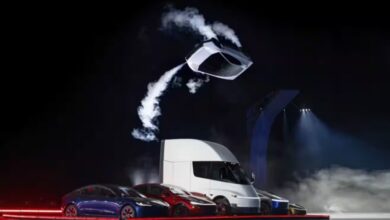


Elon Musk’s Tesla on Thursday sent dozens of self-driving taxis without steering wheels or brake pedals onto the streets of Austin, Texas, during an on invitation-only launch event. The renowned EV maker on the launch promised that Americans would overcome their fears of rides with “no control” and hop inside.
The rollout of the gold-coloured Teslas, which give passengers no way to take control in an emergency, comes as the company prepares to launch the service in other cities. After drop in shares amid a slump in vehicle sales, Tesla however rose more than five percent on Thursday with hopes that the futuristic-looking taxis will cushion further market slump.
“No steering wheel, no pedals,” Tesla teased on X before the launch, and Musk followed with a post showing a giant Cybercab floating above the Austin skyline and later wrote: “A Storm of Cybercabs.” Tesla trails self-driving taxi leader, Waymo, in the number of cabs deployed and trips completed.
To catch up, it must demonstrate that its camera-only system can safely navigate streets and avoid pedestrians. By contrast, Waymo and another rival, Amazon’s Zoox, supplement cameras with radar and a laser-based technology called lidar. A Pew Research Center survey conducted in February found that seven in 10 US adults were “not too” or “not at all” comfortable riding in a driverless car.
Tesla stock was battered last year after Musk took over President Donald Trump’s government cost-cutting campaign, dubbed DOGE, and embraced extreme-right political candidates, sparking protests at Tesla showrooms and boycotts by car buyers in several countries.
Even if the technology works well, Americans still need to be convinced. Tesla posted a second consecutive annual decline in vehicle sales last year. Its profits plunged, and it lost its crown as the world’s bestselling electric vehicle maker to China’s BYD.
Austin has had a self-driving Tesla ‘robotaxi’ service since June last year, but those cars are equipped with steering wheels and brake pedals. The service, which has since expanded to five other cities in Texas and Florida, initially carried passengers with safety drivers aboard to take over in case of problems.
Tesla has more than 200 ‘unsupervised’ robotaxis in those cities, meaning they operate without safety drivers aboard, according to the monitoring site RobotaxiTracker. Waymo has more than 4,000 such vehicles in 14 cities. In the Pew survey, 16 percent of US adults said they would be “somewhat” comfortable riding in a driverless car while seven percent said they would be “extremely” or “very” comfortable.
Separate Gallup polling conducted in 2025 found that skepticism about the safety of driverless cars had risen over the previous several years. More Americans said all or mostly human-operated cars were the safest option than in a 2018 poll. It is unclear whether Musk is the right person to coax people into cars with no human controls.
Another Pew poll conducted in January found that nearly six in 10 US adults had a “very” or “mostly” unfavorable view of him. Musk eventually hopes to send full selfdriving software to hundreds of thousands of Teslas through a software update.
That would allow Tesla owners to turn their cars into taxis for hire when they are not using them. But regulators in the U.S. and overseas have signaled that he still has some convincing to do. Tesla has not received approval for drivers to use even its partial self-driving software in most European Union countries while the US, where the software has been downloaded and used, regulators have opened several investigations into its safety.
One probe is examining the software’s role in several Tesla crashes in fog, sun glare and other low-visibility conditions, including one in which a pedestrian was killed. Another is investigating dozens of incidents in which Teslas using partial self-driving software ran red lights or drove on the wrong side of the road, sometimes crashing into other vehicles and causing injuries.
A third is examining why Tesla apparently violated regulatory requirements by failing to report crashes promptly.