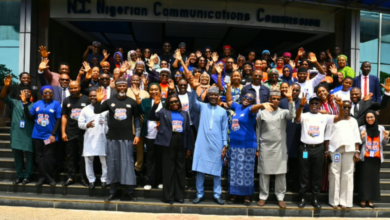
Africa must not just adopt, but shape global AI, cybersecurity standards — Maida


Executive Vice-Chairman (EVC) of the Nigerian Communications Commission (NCC), Aminu Maida has urged African countries to play a bigger role in shaping global standards on artificial intelligence (AI), spectrum management, cybersecurity and digital governance rather than merely adopting them.
Maida, who spoke on African Telecommunications Union (ATU) Conference of Plenpotentiaries (CPL) in Abuja, said the continent’s influence in international digital policy would depend on sustained technical participation, coherent positions and stronger collaboration among member states.
“Our objective as Africa is not to resist global standards. It is to help shape standards that are globally sound and sufficiently informed by African realities.
“The scale of mobile adoption, the innovation we have seen in digital financial services, and the number of young people coming online means that decisions on spectrum, digital identity, artificial intelligence, connectivity, and digital trust will have profound consequences across our continent.
“African perspectives should therefore not be treated as an afterthought. They should form part of the discussion from the outset,” Maida said.
He noted that the preparatory committee would review the ATU’s activities between 2023 and 2026 and develop recommendations to be presented at the union’s conference of plenipotentiaries (CPL-26), while also harmonising Africa’s position ahead of the International Telecommunication Union (ITU) Plenipotentiary Conference (PP-26).
“Africa must prepare together, work together between meetings and arrive at global forums with positions that are both coherent and technically compelling,” Maida said.
“Africa’s influence in international forums does not depend simply on the size of our delegations or the number of interventions we make. It depends on the quality of our preparation, the coherence of our the coherence of our positions and the consistency with which we advance them.”
The EVC added that issues such as spectrum harmonisation, artificial intelligence governance, cybersecurity, data protection and universal connectivity require stronger regulatory cooperation among African countries, adding that collaboration should extend beyond conference meetings.
Maida proposed more structured coordination through designated national focal points, regular technical engagements, shared evidence and continuous development of common African positions.
Maida also called for greater African participation in ITU study groups and technical committees, noting that the continent must contribute to shaping global standards rather than merely adopting them.
“No administration can address these challenges effectively in isolation. Our regulatory approach, or rather our regulatory cooperation must therefore become more continuous, more technical, and more institutionalised,” he said.
The NCC boss noted that Africa’s rapidly growing digital economy, expanding mobile adoption and youthful population make it imperative for the continent to play a more active role in determining global policies on connectivity, artificial intelligence and digital trust.
Earlier, permanent secretary of the Federal Ministry of Communications, Innovation and Digital Economy, Nadungu Gagare said Nigeria remains committed to supporting the objectives of the ATU and advancing regional digital integration.
Garage, who represented the Minister of Communications, Innovation and Digital Economy, Bosun Tijani, said the recommendations from the preparatory committee would lay the foundation for decisions to be taken at the forthcoming conference of plenipotentiaries, while strengthening collaboration among member states to drive inclusive digital development across Africa.
Also at the event, the director of Internal Audit at the NCC, Stella Erebor was elected chairperson of the conference preparatory committee (CPC) of the ATU.
Erebor emerged as chair at the committee’s meeting in Abuja on Monday ahead of the seventh ordinary session of the ATU Conference of Plenipotentiaries (CPL-26), where African ICT ministers will consider the union’s work over the past four years and chart its priorities for the next four years.
Speaking after her election, Erebor said the committee is responsible for preparing the reports, resolutions and other documents that will be presented to the conference of plenipotentiaries later in the week.
She said the committee also reviewed the ATU’s activities over the past four years, particularly efforts to coordinate African countries’ participation in the ITU and strengthen the continent’s voice on global telecommunications and digital policy issues.
Also speaking, secretarygeneral of the ATU, John Omo said the conference of plenipotentiaries serves as the union’s highest decisionmaking body, bringing together ICT ministers from member states to review the organisation’s performance and set its strategic direction.
He said African countries face similar digital development challenges, making it important to develop common positions on policy, regulatory and operational issues before engaging at global forums.
Omo added that the conference will also elect a new ATU secretary-general to succeed the incumbent, whose tenure ends this year.