

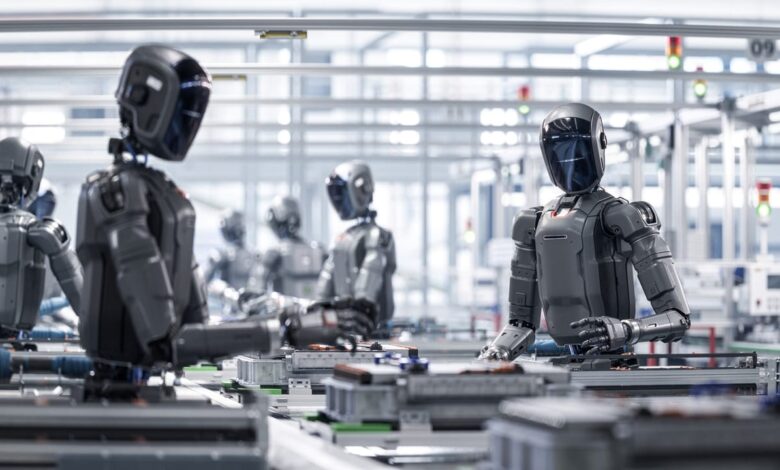
Doing laundry, working as a cashier, sorting packages and even outpacing the Earth’s fastest human are among the roles showcased at a week-long robot conference and games event in Beijing. The demonstrations offer a glimpse of the future China is pursuing for humanoid robots.
Yet, despite the spectacle, experts remain doubtful that humanoid robots can replace human workers in the short term in most cases.
However, China’s ageing and shrinking population is gradually eroding a critical demographic advantage for its industrial base: a vast labour force. As a result, the country has a strong incentive to develop humanoids capable of handling labour-intensive work.
Speaking on China’s humanoid robot race in recent time on the sidelines of this week’s World Robot Conference, head of Automation at Robotics Consultancy, Georg Stieler said: “I think the hardware has become more reliable. We saw some improvements there, but to do some really useful jobs, I’m still looking for it. And we’re following this space very closely.”
China’s humanoid race has partly been built around spectacle. Robots have danced and boxed on television, symbolising President Xi Jinping’s “new quality productive forces” — technology-led growth built on advanced manufacturing and innovation.
However, some analysts question whether a general-purpose machine built in the human image makes economic sense. Robotic arms designed for specific manufacturing tasks are cheaper, more reliable and already widely used.
Beijing’s development of embodied artificial intelligence follows the industrial-policy blueprint it deployed for electric vehicles and solar panels. The strategy identifies a strategic sector, mobilises government money, builds capacity early and encourages fierce competition to drive down costs.
Such investment supports China’s ambition to gain control of critical industrial technology and displace Western competitors.
“It reminds me a bit of the early days of the electric vehicle industry. There was also a lot of waste and exaggeration, but at the end of the day, a lot of it stuck and it helps to bring some global industry out of their traditional balance. And I think the same will happen in the robotics industry,” Stieler said.
Humanoids Still Face Major Obstacles
Yet cars and solar panels were mature industries when Chinese subsidies accelerated their production. Humanoid robots remain an early-stage technology with limited demand and no significant export market.
Meanwhile, analysts and industry executives say the technology still faces unresolved problems with dexterity, reliability, intelligence and cost.
Government entities are also major funders and customers of the same robots. Consequently, this dynamic can make demand appear stronger than it really is.
That makes China’s gamble on humanoids a riskier prospect.
National, provincial and local governments spent at least $230 million buying humanoids and related items in the first half of the year. That was up from $62 million a year earlier and $6 million in the corresponding period of 2024, public procurement data show.
Reuters reviewed nearly 1,000 fulfilled tenders covering state entities’ purchases of robots, training systems, equipment and demonstration projects.