

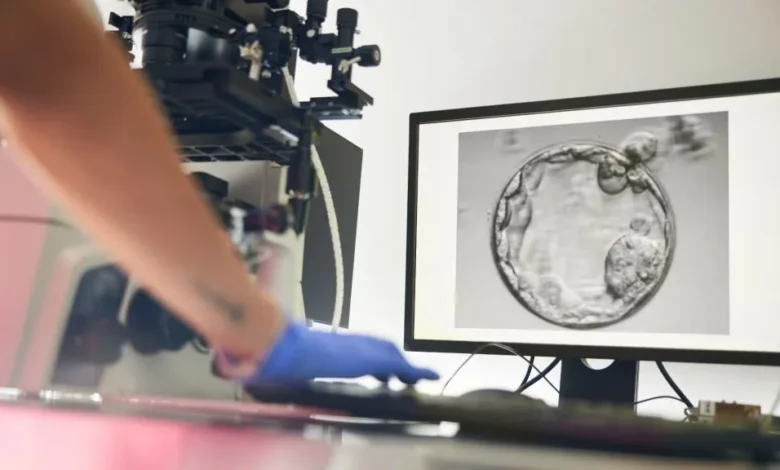
Artificial intelligence (AI) developed by scientists at Columbia University is helping doctors to find sperm cells in men who were previously told they had none. The model, developed at the university’s Fertility Centre’s Star uses AI to detect rare sperm missed in standard tests, opening a new path to biological parenthood for some couples.
According to a report by the BBC, the method, called Star, short for Sperm Track and Recovery, developed by the Columbia University Fertility Center, uses artificial intelligence to scan semen or tissue samples to locate extremely rare sperm cells that standard lab methods often miss.
The approach could allow some men once considered infertile to use their own sperm in treatment. Azoospermia, the condition the method targets, means no sperm can be detected in a man’s semen using conventional testing. It affects about 10 percent of infertile men and roughly one percent of all men overall.
In the invention, first announced in 2025, Star combines imaging, AI, and robotics to search for sperm. According to the BBC report, samples move through microfluidic chips, small devices etched with channels as thin as a human hair that guide fluid in a controlled way.
As the sample flows through, an imaging system captures about 300 images per second. A machine learning algorithm, a type of AI trained to recognise patterns, analyses those images in real time to identify sperm among debris and other cells.
Researchers said a robot isolates sperm within milliseconds, avoiding centrifugation, a spinning method that can damage fragile cells. Doctors can then use the sperm in in vitro fertilisation, or IVF, where an egg is fertilised outside the body. The news comes as doctors and researchers are expanding the use of AI in medicine.
In April, OpenAI said a version of ChatGPT designed for clinicians outperformed human physicians on certain clinical tasks, while Mayo Clinic researchers reported an AI model that can detect pancreatic cancer years earlier than doctors by identifying subtle changes in routine scans.
Director of the Columbia University Fertility Centre, Zev Williams said the method has found sperm in just under 30 percent of patients tested. These patients had previously been told they had no chance of producing usable sperm.
He also said the method identified 40 times more sperm than manual searches by trained technicians, achieving a 100 percent sensitivity rate.