

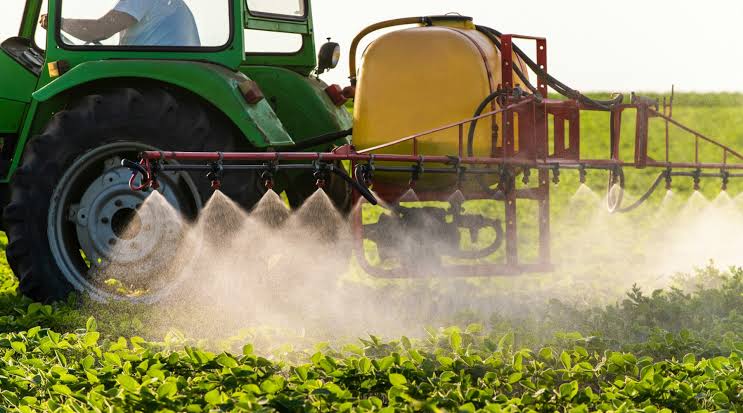
A team of researchers at MIT and a spinoff company they launched has developed a system to do just that. Their technology adds a thin coating around droplets as they are being sprayed onto a field, greatly reducing their tendency to bounce off leaves and end up wasted on the ground. Instead, the coated droplets stick to the leaves as intended. The research is described in the journal Soft Matter, in a paper by recent MIT alumni Vishnu Jayaprakash PhD ‘22 and Sreedath Panat PhD ‘23, graduate student Simon Rufer, and MIT professor of mechanical engineering Kripa Varanasi. A recent study found that if farmers didn’t use pesticides, they would lose 78 percent of fruit, 54 percent of vegetable, and 32 percent of cereal production. Despite their importance, a lack of technology that monitors and optimizes sprays has forced farmers to rely on personal experience and rules of thumb to decide how to apply these chemicals.
As a result, these chemicals tend to be over-sprayed, leading to runoff and chemicals ending up in waterways or building up in the soil. Pesticides take a significant toll on global health and the environment, the researchers point out. A recent study found that 31 percent of agricultural soils around the world were at high risk from pesticide pollution. And agricultural chemicals are a major expense for farmers: In the U.S., they spend $16 billion a year just on pesticides. Making spraying more efficient is one of the best ways to make food production more sustainable and economical. Agricultural spraying essentially boils down to mixing chemicals into water and spraying water droplets onto plant leaves, which are often inherently water-repellent. “Over more than a decade of research in my lab at MIT, we have developed fundamental understandings of spraying and the interaction between droplets and plants — studying when they bounce and all the ways we have to make them stick better and enhance coverage,” Varanasi says.
The team had previously found a way to reduce the amount of sprayed liquid that bounces away from the leaves it strikes, which involved using two spray nozzles instead of one and spraying mixtures with opposite electrical charges. But they found that farmers were reluctant to take on the expense and effort of converting their spraying equipment to a two-nozzle system. So, the team looked for a simpler alternative. They discovered they could achieve the same improvement in droplet retention using a singlenozzle system that can be easily adapted to existing sprayers. Instead of giving the droplets of pesticide an electric charge, they coat each droplet with a vanishingly thin layer of an oily material. In their new study, they conducted lab experiments with high-speed cameras. When they sprayed droplets with no special treatment onto a water-repelling (hydrophobic) surface similar to that of many plant leaves, the droplets initially spread out into a pancake-like disk, then rebounded back into a ball and bounced away.
But when the researchers coated the surface of the droplets with a tiny amount of oil — making up less than 1 percent of the droplet’s liquid — the droplets spread out and then stayed put. The treatment improved the droplets’ “stickiness” by as much as a hundredfold. “When these droplets are hitting the surface and as they expand, they form this oil ring that essentially pins the droplet to the surface,” Rufer says. The researchers tried a wide variety of conditions, he says, explaining that they conducted hundreds of experiments, “with different impact velocities, different droplet sizes, different angles of inclination, all the things that fully characterize this phenomenon.” Though different oils varied in their effectiveness, all of them were effective. “Regardless of the impact velocity and the oils, we saw that the rebound height was significantly lower,” he says. The effect works with remarkably small amounts of oil. In their initial tests they used 1 percent oil compared to the water, then they tried a 0.1 percent, and even .01.
The improvement in droplets sticking to the surface continued at a 0.1 percent, but began to break down beyond that. “Basically, this oil film acts as a way to trap that droplet on the surface, because oil is very attracted to the surface and sort of holds the water in place,” Rufer says. In the researchers’ initial tests they used soybean oil for the coating, figuring this would be a familiar material for the farmers they were working with, many of whom were growing soybeans. But it turned out that though they were producing the beans, the oil was not part of their usual supply chain for use on the farm. In further tests, the researchers found that several chemicals that farmers were already routinely using in their spraying, called surfactants and adjuvants, could be used instead, and that some of these provided the same benefits in keeping the droplets stuck on the leaves.
“That way,” Varanasi says, “we’re not introducing a new chemical or changed chemistries into their field, but they’re using things they’ve known for a long time.” Varanasi and Jayaprakash formed a company called AgZen to commercialize the system. In order to prove how much their coating system improves the amount of spray that stays on the plant, they first had to develop a system to monitor spraying in real time. That system, which they call RealCoverage, has been deployed on farms ranging in size from a few dozen acres to hundreds of thousands of acres, and many different crop types, and has saved farmers 30 to 50 percent on their pesticide expenditures, just by improving the controls on the existing sprays.
That system is being deployed to 920,000 acres of crops in 2025, the company says, including some in California, Texas, the Midwest, France and Italy. Adding the cloaking system using new nozzles, the researchers say, should yield at least another doubling of efficiency. “You could give back a billion dollars to U.S. growers if you just saved 6 percent of their pesticide budget,” says Jayaprakash, lead author of the research paper and CEO of AgZen. “In the lab we got 300 percent of extra product on the plant. So that means we could get orders of magnitude reductions in the amount of pesticides that farmers are spraying.” Farmers had already been using these surfactant and adjuvant chemicals as a way to enhance spraying effectiveness, but they were mixing it with a water solution. For it to have any effect, they had to use much more of these materials, risking causing burns to the plants. The new coating system reduces the amount of these materials needed, while improving their effectiveness