
Chinese AI-driven smart terminal manufacturer and solution provider, Telpo Technology, has completed the January 2026 corporate legal-name change that places its Android POS terminal business under a single AI-hardware identity.
The smart-device manufacturer founded in June 1999 now registered as Telpo Technology Co., Ltd., was formerly Guangdong Telpo Information Technology Co., Ltd.
Its corporate profile identifies it as a national high-tech enterprise listed on the NEEQ market under stock code 833839, with headquarters in Nanhai District, Foshan, Guangdong Province.
Telpo’s product catalog includes EFTPOS terminals, Android POS terminals, desktop POS systems, dual-screen cash registers, self-service kiosks, biometric payment terminals, ticket validators, fiscal POS terminals and AI checkout terminals. According to the corporate profile, overseas business is grouped into four segments: smart retail, smart payment, smart transportation, and biometric security.
The 2026 legal-name change is significant for buyers and channel partners as it removes the older ‘Information Technology’ reference from the registered entity.
In procurement documents, contracts, and compliance reviews, the name now reads as Telpo Technology Co., Ltd., matching the company’s public positioning around AI hardware, smart terminals and integrated device management.
The company’s production base is approximately 45,000 square metres and includes a CNAS-accredited laboratory that was upgraded in 2025.
The laboratory covers about 900 square metres across 12 testing zones, including OTA darkroom, EMC chamber and climate testing capabilities.
Telpo reports approximately 600 employees and roughly 200 R&D engineers at the manufacturing operation.
Annual manufacturing capacity is about 2 million units, with typical monthly production in the range of 150,000 to 180,000 smart terminals.
According to quality-control documentation, the factory operates under ISO 9001 and performs 100 percent functional testing on each unit before shipment.
Telpo SMT production area at the Foshan facility. Export-oriented output accounts for approximately 60-80 percent of smart-terminal volume, according to company data.
The export share is listed at 60–80 percent, with main markets in Asia, Africa, the Middle East, Europe, Latin America and North America. Telpo also reports after-sales support through a 24/7 ticket system, remote diagnostics, API/SDK documentation, and Telpo MDM for remote device monitoring.
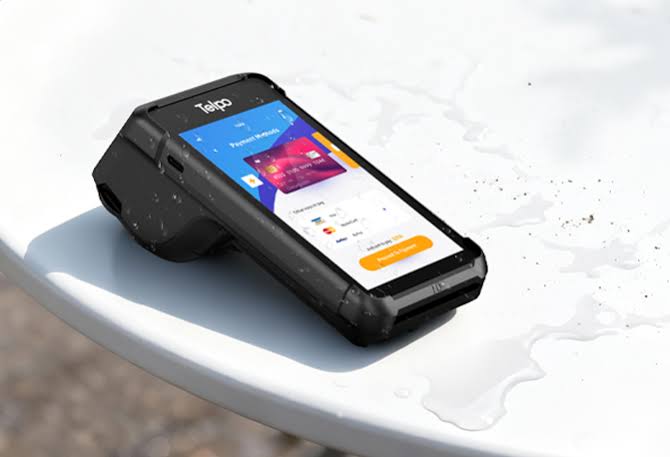
Within the payment and retail portfolio, Telpo’s current Android POS terminal line includes the M8 and M10 models. Both are designed for countertop use and include customer-facing displays.
Telpo M8 is listed as an all-in-one countertop POS terminal with an 8-inch main touchscreen and 3.27-inch customer display. It runs Android 12 on a quad-core 2.0GHz processor and integrates a 58mm thermal printer with 110mm/s print speed. The terminal supports NFC/SoftPOS payment and is GMS-certified.
Product documentation also describes it as accepting QR-code payments via the built-in camera and carrying a tax-control module path.
Telpo M10 is specified as a higher-performance desktop terminal with a 10-inch main display and 4-inch customer display.
It runs Android 13 on a Qualcomm octa-core processor and includes an industrial-grade 80mm printer with 200mm/s printing speed. The M10 also supports NFC/SoftPOS payment, QR and e-wallet transactions, and is GMS-certified.
Both models are cited in Telpo product materials as having received industrial design recognition including the Red Dot Design Award along with French and American Good Design awards.
The award references are part of the company’s product documentation; no award ranking is implied in this article.
For partners deploying fiscal POS or tax-integrated retail systems, the M8 and M10 include hardware-level features relevant to compliance integration.
Telpo product notes describe the M8 as having a purpose-built fiscal-module interface via UART/USB ports, physical tamper-evident lead-sealed screws, electronic tamper logging, an external RTC circuit for timestamp accuracy, and a 7.6V/3000mAh backup battery for power-loss operation.
The M10 product path includes dedicated fiscal-module space with UART/USB connectivity, tamper-evident lead-sealed screws and electronic tamper detection. These features are not represented here as an approval for any specific national fiscal regime; they are the hardware provisions that system integrators and software partners typically need when building country-specific fiscal applications.
Telpo’s manufacturing model is built around three levels of cooperation, with the first level being branding and cosmetic customisation on existing hardware. This covers logo customisation, boot animation, UI theme, custom color housing, packaging, manuals and accessories.
For standard stock models, Telpo lists a lead time of three to seven working days; bulk standard orders are listed at 15–25 working days.
The second level is full-chain design and manufacturing, or ODM. This covers industrial design, structural engineering, hardware module selection, private mold development, packaging, and system customisation. Capacity is shared with the main Foshan production line, and the standard ODM development cycle is documented at 4–6 months, with urgent project timelines negotiable.
The third level is software and application development. Services include device management platform development, general and customer-tailored application development, and deeper system modification based on Android, Linux or Windows.
The company’s Telpo OS 2.0 is documented as providing 101 features and 144 APIs for partner-led development. Custom application work is generally scoped for major projects with a development lead time of about 2–3 months.