
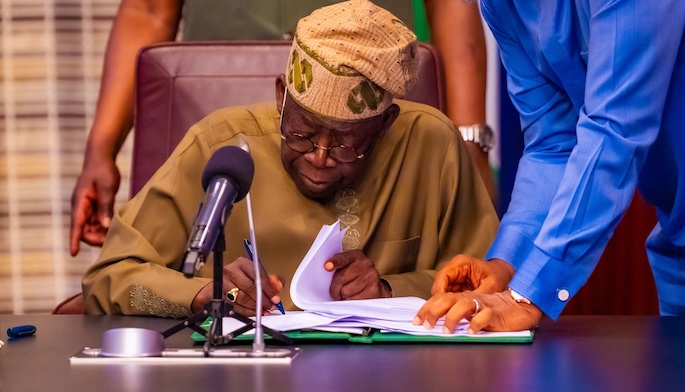
President Bola Tinubu has ordered sweeping reform to the administration of Nigeria’s oil and gas revenues, directing that all earnings due to the federation be remitted directly to the Federation Account. With the directive, the president has suspended the collection of certain fees previously retained by the Nigerian National Petroleum Company Limited (NNPCL). The directive, contained in an Executive Order signed last week, was disclosed on Wednesday in a statement by the Federal Ministry of Finance through its assistant director of Information and Public Relations, Uloma Amadi.
The Executive Order mandates the direct remittance of taxes, royalties, and profit oil accruing under Production Sharing Contracts to the appropriate fiscal authorities, effectively ending deductions at source. According to the Ministry of Petroleum Resources, the measure is designed to realign oil and gas revenue flows with constitutional provisions, improve fiscal transparency, and curb leakages that have weakened inflows into the Federation Account in recent years.
The statement noted that the order aims to strengthen fiscal transparency, clarify regulatory mandates, and enhance revenues accruing to the Federation from the oil and gas sector. It added that the reforms reinforce provisions of the 1999 Constitution, which vest ownership of mineral resources in the Federation and require that all revenues derived from them be paid into the Federation Account for appropriation in accordance with constitutional and statutory rules. A key component of the directive is the suspension of NNPC’s collection of management fees and frontier exploration deductions.
The Order also halts the payment of gas flare penalties into the Midstream Gas Infrastructure Fund and clarifies the delineation of regulatory responsibilities between the Nigerian Upstream Petroleum Regulatory Commission and the Nigerian Midstream and Downstream Petroleum Regulatory Authority. To ensure effective implementation, the government has constituted an interagency committee chaired by the Minister of Finance and Coordinating Minister for the Economy to oversee compliance and coordinate execution across relevant institutions.
Officials explained that the directive also addresses fiscal and structural arrangements introduced under the Petroleum Industry Act that have resulted in off-budget allocations and deductions from Federation revenues. Under the existing framework, significant portions of oil earnings are deducted at source to fund frontier exploration activities and management fees, a practice that government officials say has contributed to declining net inflows despite improved production levels and relatively favourable market conditions. The ministry described the reform as both urgent and necessary, citing sustained declines in oil and gas revenue inflows into the Federation Account.
According to the statement, the shortfall has constrained the government’s ability to meet budgetary obligations and finance critical public investments in education, healthcare, and infrastructure. It emphasised that the oil and gas sector must operate in a manner that delivers transparent and constitutionally compliant revenue flows and ensures that hydrocarbon resources are converted into sustainable revenues, investment, and economic activity that benefit the broader economy.
The reforms come at a time of rising domestic fiscal pressures and heightened global competition for energy capital. The ministry observed that global energy markets are becoming increasingly competitive and that investment capital is more selective, warning that Nigeria cannot afford inefficiencies in managing its most strategic economic asset. Economic analysts say improved transparency and predictable revenue flows are essential to strengthening investor confidence and stabilizing public finances.
The Executive Order takes immediate effect and is described as an interim corrective measure pending legislative amendments that would entrench the reforms in statute. Policy observers note that the directive signals tighter federal oversight of oil revenue administration and could reshape cash flow structures within the sector, particularly regarding NNPC’s cost recovery processes and funding mechanisms.
Documents presented at the September 2025 Federation Account Allocation Committee meeting indicated that NNPCL received N318.05 billion between January and August 2025 for frontier oil exploration. The deductions represented 30 percent of Production Sharing Contract profits automatically set aside monthly for inland basin exploration, with an equivalent 30 percent applied as management fees.
Director-general of the Budget Office of the Federation, Tanimu Yakubu, previously warned that Nigeria had lost nearly 60 percent of its gross oil revenue to deductions under the Petroleum Industry Act framework and disclosed that efforts were underway at the National Assembly to amend the law and recover part of the revenue. President Tinubu had earlier called for a reassessment of the NNPCL’s 30 percent management fee and 30 percent frontier exploration deduction structure and tasked the Economic Management Team, chaired by Finance Minister Wale Edun, with presenting actionable recommendations to the Federal Executive Council on the optimal way forward.
Government officials say the measures represent a significant step toward strengthening fiscal discipline, safeguarding revenue integrity, and ensuring that Nigeria’s natural resources deliver tangible value to citizens, investors, and the wider economy. The directive underscores the administration’s broader effort to improve public finance management and ensure that revenues derived from the nation’s most strategic economic asset are fully accounted for and deployed in the national interest.