

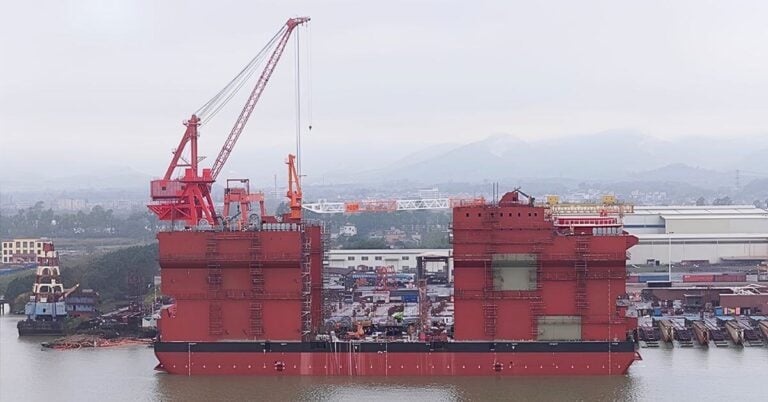
China last week unveiled its largest semi-submersible crane vessel by lifting capacity. This new vessel called Sihang Yongsheng, handed over in Jiangmen, Guangdong Province, will help the counry take on major offshore construction projects.
According to state media, the crane is also expected to support the construction of cross-sea bridges, ports, offshore wind farms, marine ranches, and deep-sea resource exploration.
Jiangmen Hengtong Shipbuilding, a subsidiary of CCCC Fourth Harbor Engineering Co., built the vessel to handle both heavy lifting and offshore transport.
It measures 361 feet (110 metres) long, 144 feet (43.8 meters) wide, and has a 51,700-square-foot (4,800-square-metre) deck for moving large offshore structures.
The Sihang Yongsheng has a fully rotating luffing crane at its stern, a 489-foot (149-metre) boom and can lift cargo to a height of 566 feet (172.5 metres), which is about the height of a 50-story building.
When anchored, the crane can lift 2,200 metric tons (about 2,425 U.S. tons) at once. This makes it the largest fully rotating semi-submersible crane vessel in China in terms of lifting capacity. According to China Media Group, the crane can rotate a full 360 degrees while the vessel stays anchored.
This makes it easier for crews to install large offshore wind turbine foundations, steel structures, and bridge sections. The vessel can also transport components weighing up to 10,000 metric tons (about 11,023 US tons) on its deck.
It can also lower itself into the water to switch to semisubmersible mode, so it can handle both heavy lifting and cargo transport for offshore projects. The vessel has a smart load adjustment system that automatically checks conditions and keeps the vessel balanced without human help.
Developers say this technology helps solve common problems in offshore construction, such as harsh working conditions, limited lifting efficiency, and complex installation work at sea. Chief engineer at CCCC Fourth Harbor Engineering’s Hengtong Shipbuilding, Huang Chenguang said the vessel’s rotating crane and transport features were made to help handle very large offshore structures during construction.
Director of the China Centre for Energy Economics Research at Xiamen University, Lin Boqiang said larger engineering vessels make it possible to take on more types of offshore projects.
“Taking offshore wind power as an example, many large offshore platforms are now assembled on land before being transported and installed at sea by heavy-lift vessels.
Without equipment with sufficient tonnage and lifting capacity, such projects would be difficult to carry out efficiently,” Lin said.