
Google has announced a €411million (($468 million) support for Germanybased energy company, Proxima Fusion, in its plan to build Europe’s first commercial fusion power plant. The capital injection makes the Max Planck Institute for Plasma Physics spin-out the most funded fusion entity in Europe.
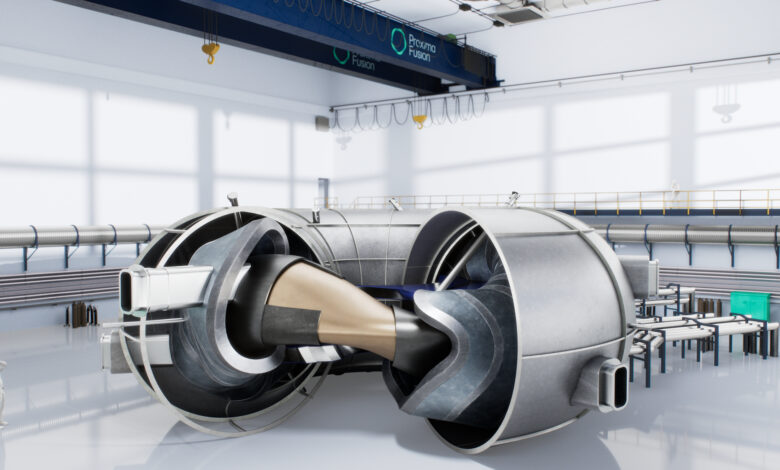
The company plans to deploy these resources toward the engineering, manufacturing, and hardware scaling necessary to build its net-energy stellarator demonstrator, named Alpha. The core of Proxima Fusion’s approach relies on the QuasiIsodynamic High-Temperature Superconducting (QI-HTS) stellarator concept.
This design builds directly upon data and physics insights generated by the Wendelstein 7-X program, an advanced stellarator experiment run by the Max Planck Institute for Plasma Physics. Stellarators utilise a complex arrangement of external magnetic coils to confine high-energy plasma in a continuous, steady state.
This configuration avoids the internal current disruptions that can challenge tokamak designs, offering a distinct pathway to stable, long-term power plant operations.
The new funding will shift Proxima’s operations from initial computational research into active industrial execution and hardware validation. Key engineering priorities include completing the proprietary Stellarator Model Coil, which acts as a foundational component for the magnet topology.
The Alpha demonstrator, located near Munich, serves as the primary hardware bridge between laboratoryscale plasma physics and commercial grid deployment.
Developed via a collaborative structure involving the state of Bavaria, the Max Planck Institute for Plasma Physics, and energy utility RWE, Alpha is designed to validate the stability of the QI magnetic configuration under high-performance conditions.
Proxima aims to operate Alpha in the early 2030s, intending to make it the first stellarator to achieve a net energy gain, where the internal plasma reactions produce more energy than the external systems consume to sustain them.
Data gathered from the Alpha system will directly inform the engineering design of Stellaris, the company’s planned commercial fusion power plant. The long-term roadmap projects deploying Stellaris to the electricity grid later in the 2030s.
To prepare for this phase, Proxima previously finalised an agreement with RWE to site the first commercial power plant at a former nuclear fission facility in Gundremmingen, Bavaria.
This strategy allows the company to reuse existing electrical transmission infrastructure, accelerating the integration of fusion power into the regional energy grid. Highlights ongoing corporate interest The €411 million private round was led by XTX Ventures and East X Ventures.
Strategic corporate investments came from RWE and Google, alongside participation from KfW Capital, SPRIND, Burda Principal Investments, and returning institutional backers such as Plural, UVC Partners, Balderton, and Lightspeed. Google’s involvement highlights ongoing corporate interest in securing firm, carbon-free energy sources for high-demand infrastructure.
The financing round exceeded its initial goal of matching the Free State of Bavaria’s €400 million public funding contribution. By combining public grants and private venture capital, the company has raised over €650 million ($740 million) within three years.
According to co-founder and chief executive officer of Proxima Fusion, Dr. Francesco Sciortino, the funding environment demonstrates that European institutions can transition advanced scientific breakthroughs out of research laboratories and into globally competitive industrial companies.