
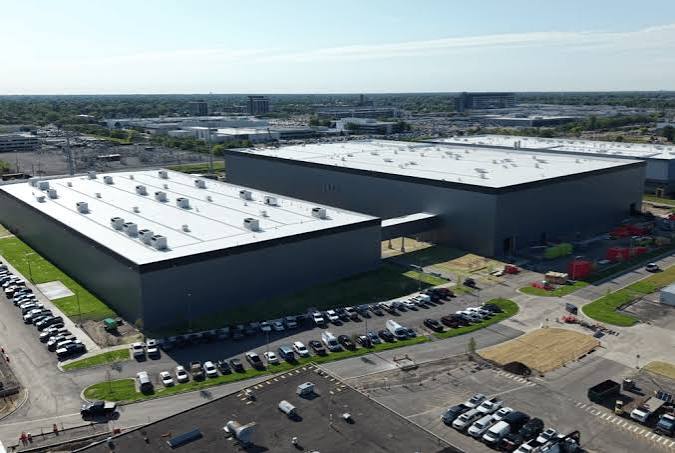
Inside those buildings, which total half a million square feet together, is a massive construction project that’s still in progress. Once completed, it will house GM’s new Battery Cell Development Center, where the automaker is working furiously to build new prototype cells with the goal of slashing the cost of its EVs. GM has to build faster and cheaper to meet its goal of selling affordable EVs in much higher volumes. Those EVs will have to compete not only with longtime sales leader Tesla, but also with the flood of Chinese EVs that, sooner or later, will land in the US. And while EV sales in the US appear to be leveling out, America has a long way to go before it can credibly compete with China, the world’s leading EV market.
The number of shoppers interested in new and used EVs spiked when gas prices rose 40 percent this year as a result of the war in Iran — but mostly in models priced lower than the average $50,000 cost of a new vehicle today. While GM sells more EVs in the US than any other company after Tesla, most of its lineup is still too expensive thanks to a battery pack that makes up 30 to 40 percent of the total cost. During an early September tour, after putting on a hard hat, safety glasses, and a hi-vis vest, I saw up close the tools GM will use to build these newer, cheaper batteries: huge vats for mixing cell slurry, coating machines that deposit electrode material onto film, and machines for a dozen other steps in the process of turning minerals into cells that hold and deliver energy.
The plant I toured will be a low-volume factory that lets engineers prototype the highervolume production to come from giant, billion-dollar factories. The new facility suggests GM is playing a long game, working to develop new cells that use less — or none — of the minerals China controls globally. Although US scientists developed the original R&D on most new cell chemistries, Asian companies were the ones to develop, refine, and put those chemistries into volume production. The 15-year Chinese effort that gave the country global control of supply and processing for minerals used in today’s cells, especially cobalt, nickel, and rare earths, means future cells must use different minerals to escape the country’s dominance. One example: GM’s new LMR, or lithium manganese-rich, cells use very little cobalt or nickel.
A second: This spring GM announced it’s working with startup Peak Energy on sodium-ion cells for energy storage. Getting such new chemistries out of the lab and into volume production can last a decade or more. But GM doesn’t have that long. China may already be selling its EVs to Americans by then. The company’s battery engineers are confident that using the new facility inside those anonymous buildings 15 miles north of Detroit can launch new cell chemistries and formats for EVs and battery energy-storage systems in less time than predicted. The company’s future will rest on whether it can succeed.
Culled from https://www.theverge.com/