
Scientists from Harvard University’s Wyss Institute, Harvard Medical School, and the Stanford Doerr School of Sustainability have genetically engineered a widespread marine bacterium to accelerate rock weathering, a natural process that removes carbon dioxide from the atmosphere and helps regulate Earth’s climate.
The research team modified Alteromonas macleodii to increase the weathering of olivine in seawater.
Rock weathering begins when silicate minerals such as olivine dissolve after exposure to water, air, and biological activity.
The process releases magnesium, iron, and silicate while converting atmospheric CO2 dissolved in water into bicarbonate.
However, the released iron oxidises when exposed to the atmosphere and forms rust over the mineral surface. This coating slows further dissolution and limits the rate at which the rock can capture carbon.
Some bacteria naturally produce siderophores, molecules that bind to oxidised iron and make it soluble. By removing this iron, the microbes effectively strip rust from the mineral surface and allow weathering to continue faster.
The researchers found that natural bacteria stopped producing siderophores once they obtained enough iron for growth.
They therefore engineered A. macleodii to continue producing the molecules regardless of surrounding iron levels.
“To enable enhanced weathering at scale, we engineered A. macleodii to always produce siderophores. We essentially decoupled siderophore production from environmental iron levels,” said first author of the research, Neil Dalvie.
Tested in custom bioreactors, the bacterium accelerated the process by 2.6-fold and increased atmospheric CO2 removal.
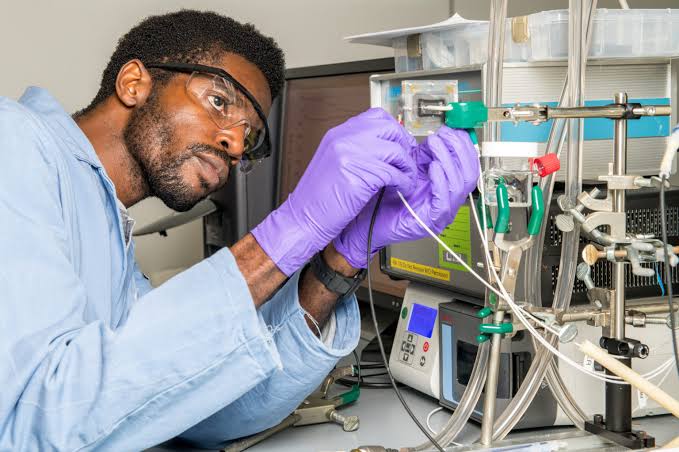
After initial experiments showed promise, the researchers built pilot-scale bioreactors containing several kilograms of green olivine and submerged in raw seawater collected from Boston Harbor.
Seawater and bacteria continuously flowed over the mineral, allowing the team to measure weathering under steady-state conditions. The system eventually absorbed 0.5 grams of atmospheric CO2 per day.
The engineered microbes increased olivine weathering by 2.6 times compared with the control conditions.
According to the researchers, the experiment provided proof that synthetic biology could accelerate a geological process that normally unfolds over extremely long periods.
“Our study embraces the concept of biologically inspired engineering and how synthetic biology can be applied to enhance normal climate-regulating processes, which ultimately could have a positive impact on our planet,” said Pamela Silver, a founding core faculty member at the Wyss Institute.
Larger basins could process seawater. The team also completed a life-cycle analysis covering carbon captured and emitted across the biological, geological, and chemical components of the system.
The assessment helped identify which operating parameters would be important for achieving net carbon removal at an industrial scale.