
South Korea will officially launch its next-generation national supercomputer with 614 petaflops (PF) of computing power this December.
Equipped with 8,496 of Nvidia’s latest graphics processing units (GPUs), the system is optimised for artificial intelligence (AI)-driven scientific research and is expected to enter the world’s top 10 supercomputer performance rankings.
South Korea’s Ministry of Science and ICT and the Korea Institute of Science and Technology Information (KISTI) announced last week that they were opening applications for the “2026 National Supercomputer No. 6 Innovation Support Programme,” targeting researchers from industry, academia, and research institutes.
Official service applications will be accepted from September 28 through October 16 via the National Supercomputing Center website, the ministry said.
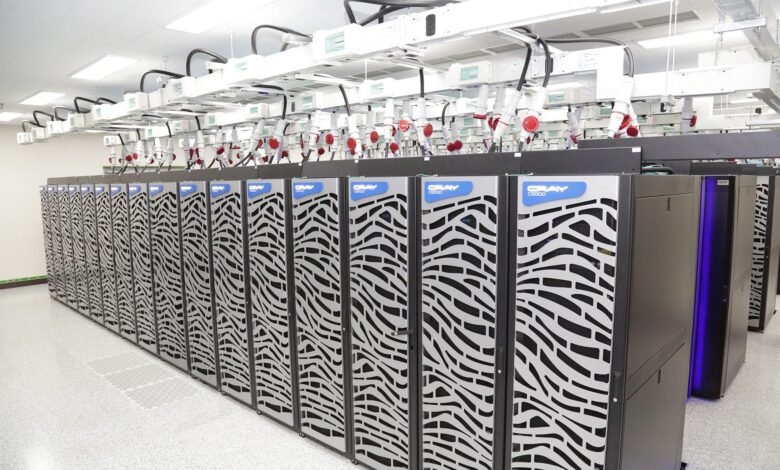
Supercomputer No. 6 is built around Nvidia’s integrated CPU-GPU chip, the GH200, featuring 8,496 GPUs and 9,936 central processing units (CPUs). Its theoretical computing performance reaches 614 PF, with 205 petabytes (PB) of storage and network speeds exceeding 400 Gbps. Compared with the existing Supercomputer No. 5, “Nurion,” the new system delivers a 24-fold increase in theoretical computing performance, 10-fold more storage, and 4-fold faster networking.
The Ministry of Science and ICT and KISTI signed a construction contract with Hewlett Packard Enterprise (HPE) in May last year and completed system installation and initial inspections last month. Performance and stability testing is currently underway, with the official service launch targeted for December.
Once Supercomputer No. 6 is fully operational, it is expected to significantly ease the burden on South Korean researchers and companies that have struggled to secure computing resources for large-scale AI research. They will be able to move beyond the current environment of purchasing expensive GPUs outright or relying on private cloud services, gaining access to massive computing resources for large-scale computational science, data simulation, and AI-based scientific research.
Total computing resources will be distributed across three programs: National Strategy (30 percent), R&D Innovation (55 percent), and Industrial Innovation (15 percent).
The National Strategy programme will prioritise core projects aimed at securing national strategic technologies, including K-Moonshot and the 7 Major SEEDs. The R&D Innovation programme — the largest allocation — targets general researchers from industry, academia, and research institutes, and is subdivided into “Grand Research” for ultra-large-scale simulations and massively parallel computing, “Creative Research” for computational science and AI studies, and “Exploratory Research” for early-stage idea validation.
The newly introduced Industrial Innovation programme is notable for providing not only computing resources but also KISTI consulting and technical support to small and mid-sized enterprises and startups that lack in-house computing infrastructure.
The Supercomputer No. 6 construction project was far from smooth. The Ministry of Science and ICT began pursuing a next-generation system in 2021 due to the aging of Supercomputer No. 5, introduced in 2018. However, the generative AI boom caused GPU demand to surge and market prices to skyrocket, resulting in four failed bidding rounds. Ultimately, the project budget had to be increased by 53 percent, from 292.9 billion won (approximately $218.8 million) to 448.3 billion won (approximately $334.9 million).
KISTI president, Lee Sik said: “As the National Supercomputing Center, KISTI is making every preparation to provide stable service for Supercomputer No. 6 based on our operational expertise. We will support the researchers and companies selected through this call to conduct more active research utilising supercomputing resources.”