

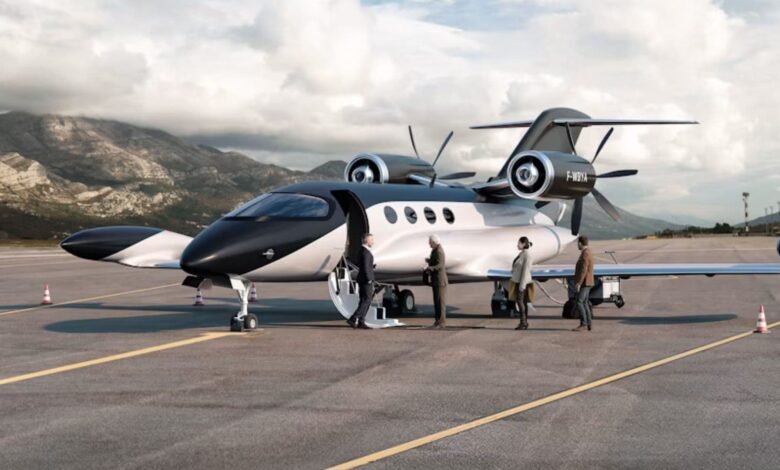
United States environmental control company, TAT Technologies is partnering French aerospace startup, Beyond Aero, to tackle cooling problems around hydrogen-electric aviation that could prove as important as the propulsion system with its planned hydrogen-electric business aircraft.
The companies are collaborating on the thermal-management architecture for Beyond Aero’s ONE aircraft. TAT’s Universal Cooling System (UCS) is being integrated into the aircraft’s design as engineers work toward a compact propulsion system capable of handling demanding heat loads.
The ONE is designed to carry six passengers for roughly 800 nautical miles. That translates to about 920 miles of range, or around five times the distance targeted by comparable battery-electric aircraft.
Fuel-cell propulsion creates a demanding thermal environment. Engineers must manage heat efficiently without adding excessive weight or consuming valuable space inside the aircraft. That makes thermal management a key part of the aircraft architecture, rather than a secondary system added later.
TAT developed its UCS as an integrated cooling platform for electric and hydrogen-electric aircraft, which can adapt across different operating conditions while targeting the tight size and weight constraints of emerging aircraft designs.
TAT Technologies chief executive officer, Igal Zamir said hydrogen propulsion offers a promising route toward lower-emission aviation. He also pointed to flexibility, efficiency and reliability as key requirements for new aircraft platforms.
Beyond Aero is developing the ONE around gaseous hydrogen storage and fuel-cell power. The company began operations in 2020 and now has more than 80 aerospace engineers across Toulouse, Paris and Los Angeles.
The range target gives the project an important distinction within electric aviation. Battery-powered aircraft face significant energy-density limits, especially when designers try to extend range without dramatically increasing battery mass. Hydrogen can offer a different path. Fuel cells convert hydrogen into electricity while producing heat that the aircraft must continuously reject, making the cooling architecture particularly important as Beyond Aero moves toward a complete aircraft configuration.
Beyond Aero’s head of Programme Industrialisation, Yannick Schwartzenbart said TAT’s aerospace experience will help the startup develop a reliable aircraft architecture. Schwartzenbart added that the partnership strengthens the industrial base supporting the hydrogen-electric program. The collaboration also gives Beyond Aero access to thermal-management expertise developed for demanding aerospace applications.
The partnership illustrates how propulsion advances can reshape seemingly secondary aircraft systems. Hydrogen tanks, fuel cells, electrical equipment and cooling hardware must all fit within a tightly constrained airframe. Engineers therefore need to consider heat rejection early in the design process. A cooling system that performs well but adds too much mass or occupies excessive space can undermine the aircraft’s overall efficiency.
Beyond Aero aims to use the ONE to bring hydrogen-electric propulsion into business aviation. The aircraft is being developed specifically around that propulsion architecture, rather than adapting an existing conventional design. TAT’s involvement places thermal management inside that broader engineering effort. If the ONE reaches commercial operation, its cooling system will be one of the less visible components helping determine how efficiently the aircraft can use hydrogen power.
