Tech Firm Introduces Gasoline-powered Helicopter Drones That Carry Military Logistics During Mission

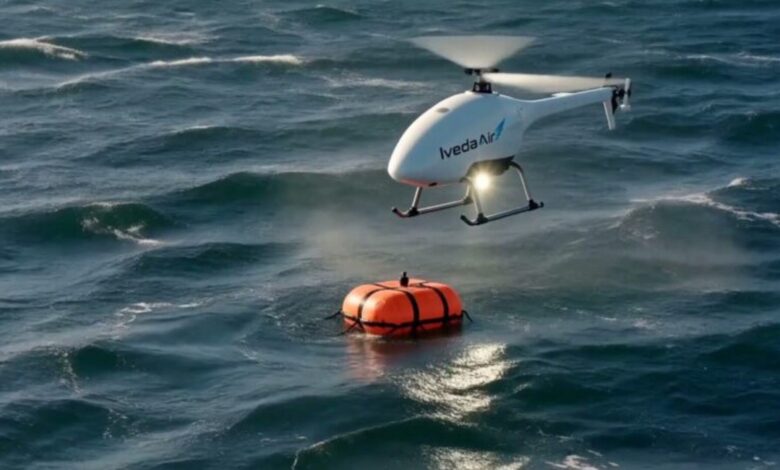
United States global technology company, Iveda, says its helicopter drones can fly up to five times longer than traditional battery-powered quadcopters.
The worldwide provider of next generation AI-driven cloud-based technologies said its GX10-F100 can remain airborne for more than 150 minutes, which it said is five times the endurance of comparable electric quadcopters.
The gasoline-powered aircraft carries up to 19 pounds of cargo during missions, with a semi-symmetrical carbon-fiber frame that targets coastal and remote operating environments.
The Iveda rotary-wing unmanned aircraft is aimed at military logistics, reconnaissance, communications support, and other operations requiring longer airborne endurance.
The aircraft uses gasoline propulsion, carries up to 19 pounds (9 kilograms) of cargo, and features a semi-symmetrical carbon-fiber airframe for operations along coastlines, in remote terrain, and in high winds.
The GX10-F100 measures 72 inches in length and has a rotor span of 72 inches, giving it dimensions comparable to compact helicopters. A 1.43-gallon fuel tank supplies the engine, while the aircraft reaches speeds of 68 mph and has an advertised operational range of 19 miles. Those figures give the aircraft a different operating profile from smaller electric systems, although actual endurance can vary with payload and conditions.
The Arizona-based company said its onboard autonomy software supports live video, route guidance, and object tracking without requiring continuous manual flight control. The company also lists coastal patrols, emergency services, infrastructure inspection, public safety, and architectural work among possible applications for the platform.
“Mission-critical operators have been forced to work within the limitations of drone systems that were never designed for the environments they operate in. This new helicopter line was built to solve that problem,” said founder and chief executive officer of Iveda, David Ly.
Beyond the military and security operations, this aircraft is also designed for emergency response and infrastructure work. Therefore, approved emergency response agencies, infrastructure companies, and military pilots can purchase the aircraft for disaster management, inspection, and other operations.
The company said governments could obtain the aircraft through GlobalMed under a federal logistics arrangement, while qualified pilots may purchase units directly. The GX10-F100 complies with federal procurement requirements for defense acquisitions and with agreements governing eligible commercial suppliers. This means that not all governments will be eligible to purchase this device, as some are blacklisted for national security.
The GX10-F100 therefore enters a market where endurance, payload capacity, and procurement eligibility can matter alongside autonomy and sensor capabilities. On the flip side, the gasoline engine introduces logistical considerations which are absent in many battery systems.
Iveda has not provided independent endurance testing showing whether the stated 150-minute figure remains achievable under maximum payload conditions. This distinction matters because aircraft performance can change substantially when carrying heavier equipment, operating against strong winds, or conducting repeated autonomous missions.
Iveda also disclosed plans to convert retired full-size helicopters into autonomous aircraft, though such a project would represent a larger class of unmanned aviation than the GX10-F100. For now, the GX10-F100 provides Iveda with an entry into military and government drone operations centered on longer flight duration.
Whether that endurance translates into a major battlefield advantage will depend on reliability, payload performance, autonomy, and actual operating conditions encountered. Iveda specialises in cloud-based video surveillance, artificial intelligence (AI) video search, and smart city Internet of Things (IoT) platforms.