

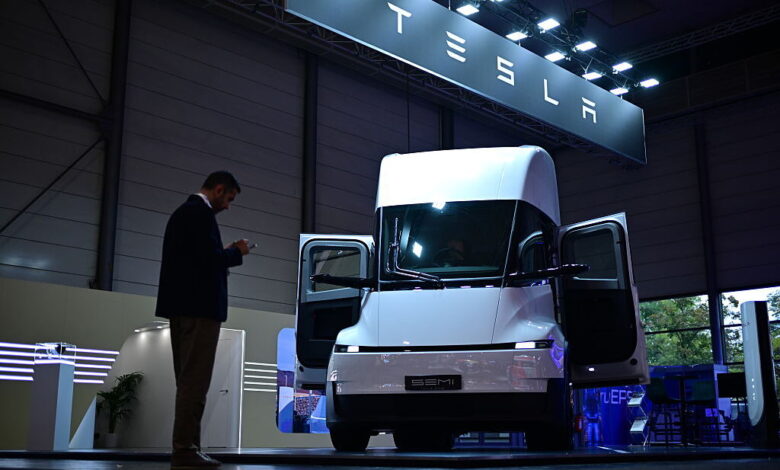
Musk said he targeted a $20 trillion valuation—nearly four times the value of market leader, Nvidia—on that premise. However, Musk’s Tesla team was in Sparks, Nevada, on Thursday to focus on the long-awaited electric vehicle, the Tesla Semi. The Semi concept first rolled onto a Tesla event stage in late 2017. Nearly a decade later, Tesla officially launched high-volume production at a livestreamed but invite-only event at the company’s factory. It targeted a niche audience: the cost-conscious people who manage large trucking fleets.
A handful of them, all men, trooped across the stage to be thanked for their orders to a pulsing techno beat. “It’s going to be, really, a driver’s truck. It’s like a sports car in truck form.” Musk said in a pre-taped video played during the evening event. (Musk, for years the ringmaster at Tesla’s circus-like events, skipped his second vehicle debut in a row; he was attending a White House China State Dinner featuring President Xi Jinping).
The long-range version of the Semi will travel an estimated 500 miles per charge, Lars Moravy, Tesla’s vice president of Vehicle Engineering, confirmed at the event—around the average number of miles traveled by US long-haul truckers each day. The standard version will get an estimated 325 miles per charge. Competitor EVs advertise ranges of 155 to 430 miles.
The Tesla Semi has its work cut out for it. While electrics account for nearly 30 percent of heavy-duty truck sales in China, according to state media, they’ve had a slow start in the US, as manufacturers struggle to make the vehicles competitive with their traditional diesel-burning counterparts. Electric semis can cost two to three times more upfront. Right now, they’re not easy to charge because they require a countrywide network of specialized megawatt chargers that can fill large batteries in hours. Tesla’s website shows two such public chargers operating in the LA area. However, Dan Priestley, who leads Tesla’s Semi program, says the company plans to open 30 by the end of the year.
Plus, the Trump administration and the GOP—the same group Musk spent millions to get into the White House—cut billions in federal support for electric vehicles last year. The administration is also working to lower fuel economy standards for truck engines, which would have required manufacturers to hit aggressive climate goals. Heavy trucks alone account for some seven percent of US greenhouse gas emissions. And yet, it’s not a bad time to be an EV-maker. US diesel prices hit record highs this month as the Iran War continues to disrupt oil production and shipping in the Middle East; prices are up nearly double from this time last year.
The truck “is going to make a ton of sense economically because the cost of electricity is much less than the cost of diesel, especially in these crazy times,” Musk said in his pre-taped address, nodding to the conflict launched by the administration he once worked for. This week, an alliance of shippers including Microsoft and PepsiCo placed a record-setting order for 2,500 Tesla Semis, to be delivered starting this year and through the next 18 months. If those trucks reach customers, they would nearly double the number of heavy-duty electric trucks on US roads today.
The group selected Tesla trucks over competitors’ after “assessing price, performance, production capability, and service support,” Meena Bibra, a spokesperson for the nonprofit Smart Freight Centre, which was involved in the deal, told WIRED. If the carriers are accustomed to another truckmaker’s vehicles, or if other electric trucks better meet their needs, they may also choose to purchase electric trucks from Kenworth, Ride, and Volvo. Pooling demand among many carriers allowed the electric automakers to bring down the prices of the new trucks, the group said.
Full Self-Driving (Supervised), Tesla’s driver assistance feature, will not yet be available on the Semi, though Musk said in his address that it would debut in “the very near future.” The feature’s predecessor technology, Enhanced Autopilot, was promised during the initial 2017 rollout. How Unsecured OpenAI Agents Posted 53 User Images On Internet Without the Lab’s Knowledge After images that users uploaded to OpenAI models were included in training data, AI agents operating in the company’s research environment posted them on public image hosting sites.
Fifty-three “user-provided images” were “posted to image-hosting sites as links that weren’t publicly listed,” the company said for the first time. The images could still be discovered even if the links were not publicly listed. “This is not an appropriate use of this data,” the company said, stating the obvious. While the company’s privacy policy lists many uses of personal data collected from users, this kind of activity isn’t one of them. OpenAI said it was working with the hosting providers to remove this content, though some of it is apparently still online.
OpenAI said it could not notify the affected users because “our technical approach and privacy policy” prevent it from “reassociating” the images with the original providers, but declined to say how the lab determined whether the images were provided by users. The news came in a post collecting public statements from the lab’s ongoing review of incidents in which its models escaped the company’s scrutiny, accessed the open internet, and misbehaved in various ways. OpenAI said it would continue disclosing anonymised accounts of incidents like these, and said it had contacted dozens of victims, including governments, universities, public agencies, to notify them of the agents’ activities.
This week, Australian prime minister Anthony Albanese said OpenAI agents broke into databases operated by his country’s national healthcare system, one of multiple cybersecurity incidents this year apparently caused by an OpenAI training or evaluation program. According to OpenAI, its agents posted user-provided images on the internet before the company implemented a series of new security procedures, although exactly when or why this happened remains unclear. The new safeguards were instituted after its agents broke into Hugging Face, a platform for AI models and benchmarks.
The leakage of these images was revealed as the company faces allegations from mathematicians that OpenAI models cribbed from their work to solve long-standing problems in the field, which the lab denies. Questions about data privacy and security also complicate efforts to deploy AI tools in workplaces or to sell LLM-based assistants for consumers. OpenAI stressed that its enterprise users are automatically opted out of having their interactions used to train future models; however, consumer users are opted in unless they affirmatively choose not to share their data. Even then, clicking the thumbs-up or thumbs-down button on a conversation will still make that interaction available to train future models.