
In February 2026, a Spanish engineer, Sammy Azdoufal, found he could take control of 7,000 smart vacuums, view live footage from people’s homes, and pinpoint their locations by reverse-engineering the connection between his DJI Romo vacuum and his PlayStation gamepad. The Chinese company quickly fixed the breach, but the incident showed how easily AI-powered surveillance technology can enter daily life. The threat is not limited to China. While China is a forerunner in using surveillance to strengthen repressive governance, similar tools are now used worldwide. In China, AI facial recognition has been used to issue jaywalking tickets, process payments and monitor students. In the UK, police have bought AI facial recognition technology to identify people on watchlists.
In the US, AI has been used in surveillance and arrest of undocumented immigrants. On the digital front, AI has also damaged the information ecosystem. Chinese generative AI DeepSeek has been reported to spread pro-China narratives, while Western tools have also been used by Russian and Chinese operators to shape public opinion. China has also rolled out a series of AI laws since 2022, covering algorithmic recommendations, deep synthesis, generative AI and AI labelling. The laws address data protection, consent and corporate responsibility for algorithmic transparency. But the laws aim to protect national security, public order and political ideology. There is no restriction on state power.
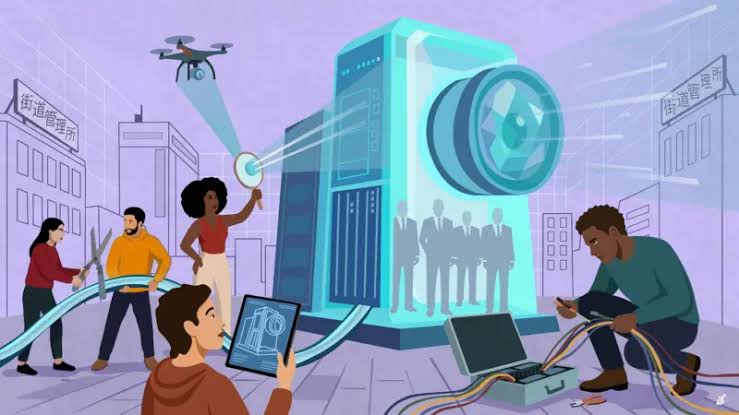
Users have complained about police knocking on their doors for buying suspicious items like drones. The social credit system, together with online censorship and grid management, tracks online activity, financial transactions and speech, and can restrict access to services when scores are low. Despite the risks, many Chinese citizens have quickly embraced new technology, including AI bots like OpenClaw. Driven by government policy and anxiety about being left behind, people have become fans of a system they do not control. The article argues that the core of a human rights approach to AI should rebalance power among the corporatestate, the machine and the people, placing people back at the centre through public deliberation, humanoriented research and humanity education.
Source: Original article by Oiwan Lam, Global Voices