
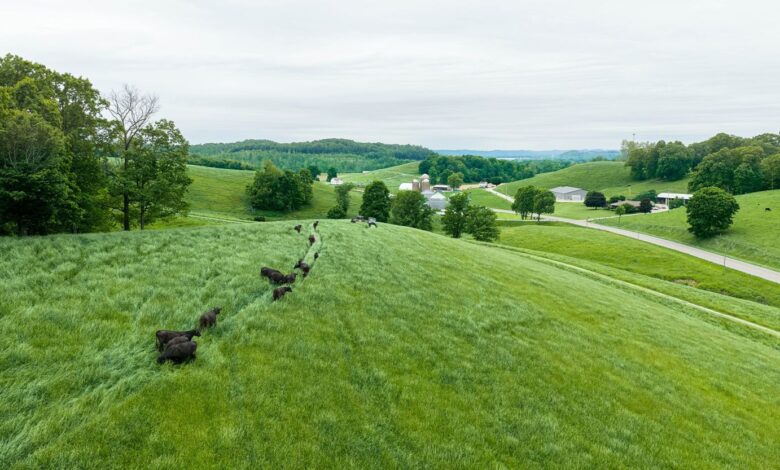
LB Porteus Farms in Ohio, a recent national sustainability award winner, is a prime example of how today’s cattle producers are blending technology and tradition to advance sustainability. “Family operations come with their ups and downs,” said Brent Porteus. “Part of that is trying to find technologies that allow us to be as efficient and environmentally friendly as we can.” Their roots in Ohio’s Muskingum River Valley stretch six generations, over which they have inherited decades of knowledge about protecting resources and caring for the land. Integrating new technology with this historical knowledge allows them to continually improve their process of raising cattle. The Porteus family operation uses a robotic, AI-supported cattle feeding system that provides greater precision in daily management.
Rather than replacing the knowledge of the people who work there, the new technology provides another layer of information to help the family make informed decisions that benefit both the land and the wellbeing of the cattle. “The efficiencies created by our feeding system mean we have even more time to focus on animal care and animal health,” says Porteus. This innovation has reduced energy and emissions to feed their cattle by 80% while also letting them spend more time on their favorite part of the job, the animals. They have also invested in a manure storage system that increases nutrient value using a new process to aerate the manure. This can then be returned to the soil to improve the health of pastures and fields.
“We are always trying to reuse and recycle those nutrients from manure,” says Porteus. To support their new technologies, LB Porteus Farms, like many across the country, has installed solar panels on their land. Porteus explained that they use about an eighth of the energy that they used previously. Each year, more technologies emerge to help cattle producers improve sustainability and efficiency. Companies have developed tools that support herd management, feed optimization, animal health, soil health, biodiversity monitoring and environmental measurement. These advancements help cattle producers gather more data than ever before, enabling them to further understand how management practices affect both productivity and natural resources.
Cattle producers combine technology with generational knowledge of land stewardship to maintain sustainable land management practices. Many farms and ranches incorporate soil sampling and forage testing to gauge the health of their soil and the plants it supports. When paired with producers’ expertise and experience, these tools help inform management decisions that benefit both cattle and the surrounding ecosystem. The effects can extend beyond the pasture, supporting robust wildlife populations and native plant species. Well-managed soil can also improve water quality, particularly on farms that are home to local watershed areas. The Porteus family constantly thinks about how management decisions affect the surrounding environment. They have been recognized for their attention to nutrient management, runoff control, soil structure and water quality, demonstrating how stewardship and cattle ranching work together.
These day-to-day decisions help ensure the operation remains productive for future generations. Investments such as these reflect a broader focus across the cattle industry. Not every farm or ranch uses the same system, a result of the widely varying ecosystems across the U.S., but there is a clear focus on using advancements to boost the generational commitment to continuous improvement. “The goal is to always leave the environment and acreage that we operate in better condition than it was yesterday,” says Porteus. “Inevitably, every year is different, but the goal is to make improvements every year in every way.” At the same time, they’re holding onto the values that have shaped farmers and ranchers for generations: stewardship, resilience and a commitment to leaving the land better than they found it.
Culled from https://edition.cnn.com/