
From a 5 a.m. Phone Call to a Continental Empire: Obasanjo Tells the Dangote Story

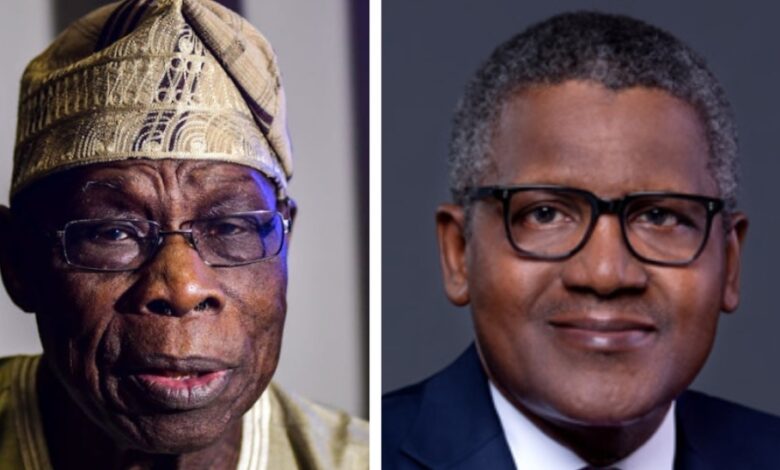
In a remarkable recollection, Obasanjo took the audience back more than two decades to a defining conversation that, in his telling, helped change the trajectory of Dangote’s business from cement importation to large-scale manufacturing and eventually into a continental industrial enterprise.
The occasion in Lamu carried significant symbolism. A Nigerian business group was unveiling an ambitious industrial project in East Africa, reinforcing the increasingly interconnected nature of African capital, enterprise and investment. For Obasanjo, however, the significance went beyond the refinery itself. It represented another chapter in a much longer story about what can happen when visionary leadership, purposeful public policy, entrepreneurial courage and long-term investment come together.
Obasanjo began by expressing his appreciation for what he described as a moment in which Africans were taking continental integration seriously. He pointed to the growing relationship between East and West Africa and credited political leadership, private enterprise and the determination of individuals willing to pursue ambitious projects despite significant challenges.
With the warmth and familiarity of someone recounting a personal chapter of history, Obasanjo recalled how his relationship with Dangote evolved around Nigeria’s struggle with cement imports. The story began in 2003, when Nigeria had already been producing cement for decades but continued to import significant quantities to meet domestic demand. Dangote was then among the businessmen importing cement into the country.
For Obasanjo, the contradiction was difficult to ignore. Nigeria had the natural resources required to produce cement, including extensive deposits of limestone, yet the country continued to spend valuable foreign exchange importing a product it could potentially manufacture locally.
According to Obasanjo, the issue troubled him so much that he made an early-morning telephone call to Dangote. It was around 5 a.m. The former president was in Abuja while Dangote was in Lagos. Obasanjo asked to see him that morning. Dangote, understandably surprised by the timing, explained that meeting at 7 a.m. would be impossible because the first flight from Lagos to Abuja was scheduled for that time. They eventually agreed to meet at 9 a.m.
When Dangote arrived, Obasanjo went directly to the issue. Why, he asked, was Dangote importing cement instead of producing it when Nigeria possessed the raw materials needed for manufacturing?
Dangote’s answer, as Obasanjo recalled it, was straightforward. Importing cement and selling it was more profitable than producing cement locally.
Rather than dismissing the response, Obasanjo saw an opportunity to understand the economic calculation behind the business decision. He asked Dangote what government could do to make local manufacturing sufficiently attractive for him to invest in production.
Dangote’s response became the basis of a new approach. If the government wanted importers to manufacture cement locally, he suggested, access to cement importation should be connected to demonstrable investment in domestic production.
Obasanjo understood the proposition. The government would create an incentive for companies benefiting from imports to build manufacturing capacity. In effect, the policy sought to shift the economic logic from simply bringing finished products into Nigeria to producing them within the country.
Dangote subsequently presented a plan to build a cement manufacturing facility capable of producing five million metric tonnes. At the time, Obasanjo recalled, Nigeria had struggled for decades to produce even a comparable volume domestically. The proposal therefore appeared ambitious, and not everyone within government was convinced.
Some officials reportedly warned the president that Dangote was simply seeking import licences and would not follow through with the promised manufacturing investment. Obasanjo, however, decided to give the businessman the opportunity to prove the plan.
He did more than that. He monitored the progress of the project closely.
Obasanjo humorously recalled that he had people monitoring activity at Dangote’s project site and would sometimes call the businessman when construction work had not taken place. The unusual level of presidential interest eventually became a source of amusement for Dangote, who reportedly told Obasanjo that he was worried because the president seemed to know more about the privately owned project than he did.
Obasanjo’s response revealed how he viewed the relationship between private investment and national development. Although the project was privately owned, he considered its success important to Nigeria. In his view, an industrial project capable of transforming domestic production was not merely a private commercial undertaking; it also had national economic consequences.
The project was eventually completed, and Nigeria commissioned the first five-million-tonne cement manufacturing facility before Obasanjo left office. But the story did not end there.
The company added more production capacity in Nigeria before extending its operations into other African markets. Investments and projects followed in countries including Tanzania, Ethiopia and Senegal. What had begun as a Nigerian effort to reduce dependence on imported cement gradually became a continental industrial strategy.
That transformation is central to the story Obasanjo told in Lamu. He was not simply recounting how one businessman became successful. He was illustrating how an industrial ambition can evolve when the right combination of policy, capital, execution and persistence is sustained over time.
The journey was not without obstacles. Obasanjo recalled Dangote’s experience in Senegal, where the company faced a prolonged dispute over the land on which its cement facility had been constructed. The difficulties reportedly delayed operations even after the plant had been completed. Yet Dangote persisted, and the company continued expanding its cement operations across the continent.
Culled from https://enterpriseceo.africa/