

America’s largest military shipbuilder, Huntington Ingalls Industries (HII), has announced a performance-based agreement worth up to $900 million aimed at bringing advanced AI-powered robotics into US Navy ship production.
The long-term deal, which is HII’s biggest automation investment yet, is with Path Robotics and GrayMatter Robotics, aimed at developing autonomous manufacturing systems capable of performing some of the most labor-intensive tasks involved in building warships.
Rather than simply replacing existing production equipment, the partnership aims to create robotic systems that can adapt to the complexity and variability of naval shipbuilding — an industry where no two projects are exactly alike.
Unlike automotive manufacturing, where robots often repeat identical tasks on standardised production lines, shipbuilding presents a far greater engineering challenge. Large steel structures vary in size, shape, and assembly sequence, requiring extensive welding, grinding, blasting, painting, inspection, and structural assembly.
According to HII, the new initiative will use physical AI, combining robotics, sensors, machine vision, and autonomous decision-making, to enable machines to perform these tasks while adapting to changing production conditions.
The companies say the goal is to develop automation capable of learning, improving, and operating in one of manufacturing’s most demanding environments.
A performance-based approach
The agreement is structured differently from a conventional defense contract. Instead of immediately awarding production work, HII will make up to $900 million in shipbuilding work available over the next seven years, provided both robotics companies achieve a series of predefined manufacturing, technology, and production milestones.
The first phase focuses on developing and qualifying autonomous production techniques that meet the stringent quality requirements of US Navy shipbuilding. These include robotic welding, grinding, blasting, painting, inspection, and fabrication processes, which will eventually be integrated into automated production lines.
If those systems demonstrate acceptable cost, schedule, and quality performance, HII plans to begin outsourcing production work through the new manufacturing network.
Beyond introducing new technology, the program is intended to address a broader challenge facing the US maritime industrial base. HII expects to outsource more than 2.5 million hours of shipbuilding work during 2026, representing a 30 percent increase compared with 2025.
The company is also expanding its distributed manufacturing network, allowing more structural sections of ships to be fabricated outside its primary shipyards before final assembly.
Initially, robotic production will focus on smaller steel structures before gradually expanding to larger units and complete modules used across multiple naval platforms.
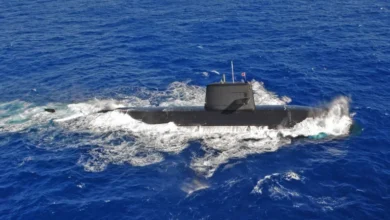
According to HII, the automation technologies are being developed for use across a wide range of US Navy programmes, including aircraft carriers, nuclear-powered submarines, destroyers, amphibious assault ships, future frigates, and unmanned surface vessels.
Because the systems are designed to work within HII’s distributed manufacturing strategy, production could eventually be shared among multiple facilities rather than concentrated entirely at major shipyards.
The collaboration is part of HII’s broader High-Yield Production Robotics (HYPR) initiative, which seeks to combine robotics, autonomous manufacturing, and industrial technology.
Modern naval shipbuilding remains one of the world’s most labor-intensive manufacturing sectors, with skilled welding and fabrication workers in particularly high demand.
While automation has transformed industries such as automotive manufacturing and electronics, shipbuilding has been slower to adopt robotics because of the size, complexity, and variability of its products.
If successful, HII’s approach could demonstrate that advances in physical AI are mature enough to automate tasks once considered too complex for machines.