

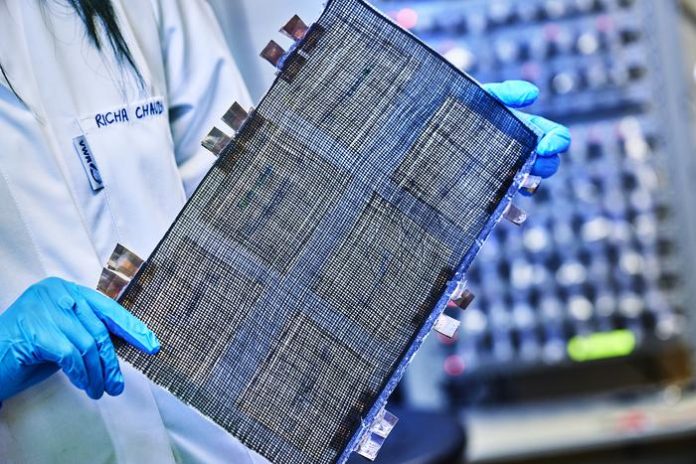
Researchers have borrowed precise manufacturing techniques from the semiconductor industry to design a copper current collector that helps lithium build up evenly during battery charging.
Electric vehicles could travel farther on a single charge if their batteries could store more energy without getting bigger or heavier. A promising alternative, known as an anode-free battery, eliminates materials such as graphite that normally store lithium during charging, saving weight and space.
Lithium instead deposits directly onto thin copper foil, where repeated charging and discharging can cause it to build up unevenly into sharp, branching spikes called dendrites. The protective layer over the lithium also becomes unstable, reducing battery performance and shortening its lifespan.
The South Korean researchers used precise manufacturing techniques from the semiconductor industry to help these batteries last longer. Their method, announced by the Korea Advanced Institute of Science & Technology (KAIST), Daejeon, on September 22, combines microscopic structures that distribute lithium more evenly across the copper foil with an ultrathin coating that helps a durable protective layer form during use.
When longer battery life adds weight
Some previous efforts to extend battery life have involved adding excess lithium to replace what is lost during operation or covering the surface with a thick protective film. Both approaches make the battery heavier and thicker, eroding the size and weight advantages that anode-free designs are meant to offer.
“This study shows how ultrafine fabrication techniques used in semiconductor manufacturing can create both uniform sites for lithium deposition and a stable protective layer without changing the bulk electrolyte formulation or adding excess lithium,” said Jinwoo Lee, a professor in KAIST’s Department of Chemical and Biomolecular Engineering.
Lee led the research with fellow KAIST professor Hee-Tae Jung, working with researchers from Kyungpook National University and the National NanoFab Center. He expects the technology to help accelerate the commercialisation of high-energy anode-free batteries.
MXene helps build a protective barrier
The team coated the copper foil with roughly 10 nanometers of MXene, a two-dimensional material made in extremely thin sheets. Instead of functioning as a finished protective barrier, the MXene acts like a primer, gathering the components needed to build one as the battery operates.
In the study’s LiPF6-based electrolyte, the material that carries charged particles inside the battery, the MXene surface encouraged a protective layer rich in lithium fluoride, or LiF, to form. That layer reduced unwanted reactions between lithium and the electrolyte while also suppressing dendrite growth.
Microscopic tubes give lithium more room
To control how lithium deposits on the copper beneath the coating, the researchers used secondary sputtering lithography, or SSL, a process used for precise micromachining in semiconductor manufacturing. They created an array of microscopic tubes, each about 300 nanometers in diameter and 150 nanometers in height, that increased the available surface area to roughly four times that of flat copper foil. With more surface available, lithium could spread out rather than concentrate in isolated spots and grow into spikes.
The researchers examined electrode surfaces and cross sections while minimizing exposure to air, confirming that a nanoscale protective layer formed uniformly along the MXene.