Hyundai tests world’s first autonomous robot that drives aboard moving ship


Hyundai Motor Group (HMG) has successfully tested its autonomous self-driving robot operating aboard a moving ship, which it described as the world’s first, marking a step towards safer maritime inspections.
The MobED (Mobile Eccentric Droid) mobile robot completed trials aboard the multipurpose vessel HYUNDAI DUBAI in South Korea, proving it could navigate despite constant vibration, vessel motion, and uneven surfaces.
The technology could eventually inspect enclosed cargo holds and other hazardous spaces that may be too dangerous or toxic for seafarers to enter.
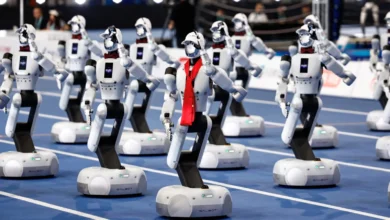
In December 2025, Hyundai first unveiled its autonomous MobED robot, a compact four-wheeled platform designed for industrial and everyday applications, ahead of future mass production.
The MobED was tested aboard the multipurpose vessel HYUNDAI DUBAI during a joint demonstration involving Korean Register (KR), HMM, HMM Ocean Service and Goseong Engineering in Changwon, South Korea.
The trial evaluated whether an autonomous robot originally designed for land-based environments could operate reliably aboard a moving ship, where constant vibration, vessel motion and uneven surfaces present unique navigation challenges.
The demonstration forms part of efforts to advance smart ship technologies by deploying robots for cargo hold inspections, condition monitoring and material transport in areas that may be hazardous or difficult for crew members to access.
During the tests, MobED successfully carried out a range of autonomous navigation tasks inside the vessel’s cargo spaces, including straight and curved driving, low- and high-speed movement, route learning and fully autonomous operation.
Its independently controlled wheel system enabled the robot to maintain stability while traversing uneven decks, inclines and thresholds commonly found aboard ships.
The platform can also be fitted with inspection equipment, cameras and delivery modules, allowing it to perform different onboard tasks. In narrow passageways, the robot completed route-learning and low-speed navigation, although operators switched it to remote-control mode because of the confined space.
The project partners said the successful demonstration showed autonomous robots can work effectively inside large cargo areas without requiring modifications to existing ship infrastructure.