Washington Climate Tech Founders Empahsise On Funding As AI Boom Drains Investor Cash

Concerns about those trends inspired a one-time Washington state initiative called the Opalene Climate Challenge, which was led by the nonprofit VertueLab. The effort announced six investments from a pool of nearly 40 applicants.
The program planned to partner with the state to secure matching dollars, but organizers realized it would take too long to raise the needed capital. Instead, they relied solely on philanthropic donors.
“The imperative was to get the money out to these climate tech startups who are doing extraordinary work but are confronting that pinch in capital,” said Allison Arnold, co-director of the Opalene Climate Challenge.
Sustainability startups that develop hardware or physical products can face a more difficult path to scale than software companies because they typically require more capital, longer development cycles and time-consuming work to manufacture, test and deploy their technologies.
The challenge aimed to fill an early-stage funding gap with recoverable grants from donor-advised funds. Successful investments will return proceeds to the donor’s fund or another designated nonprofit.
Five of the six winners are commercializing technologies developed at the University of Washington or Washington State University.
Many of the startups have participated in mentoring programs such as the Cascadia Clean Tech Accelerator or UW’s CoMotion Labs Climate Tech Incubator, or received investments from the E8 angel group.
“Those entrepreneurs who have actively sought out the resources in our ecosystem have had greater success. For most companies, it takes more than just the money,” Arnold said.
At the same time, she added, “money is what has been missing in our corner of the country. We don’t have the type of risk capital that’s available in places like Silicon Valley, Boston or New York.”
The winners were featured at an event Thursday at the Seattle Climate Innovation Hub. Recipients of $100,000 awards:
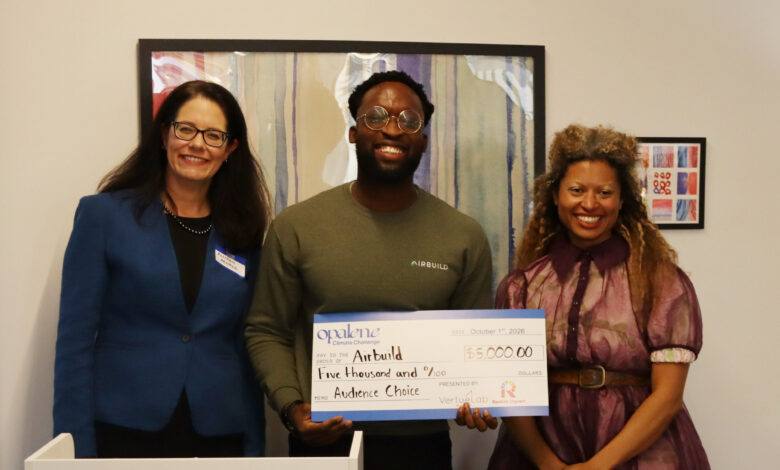
Airbuild, also the winner of the $5,000 Audience Choice Award, uses microalgae to turn wastewater treatment plants into fertiliser factories
Ocean produces low-cost, low-carbon bamboo panels for roofing and other building applications
ZILA BioWorks offers plant-based resins and epoxies to replace high-carbon alternatives
Recipients of $25,000 awards:
Azotera produces low-cost ammonia for energy storage and farm applications
Climate Solutions International offers a software platform that helps government employees analyse factors such as climate resilience, cost and carbon emissions for proposed infrastructure projects
Emerald Battery Labs builds sodium-ion batteries to replace lead-acid batteries in commercial fleets and data centers.
The Climate Pledge is a commitment to reach net-zero carbon emissions by 2040, co-founded by Amazon and Global Optimism in 2019.
Seven years later, the community has grown to over 700 signatories across 62 industries and 49 countries and territories, reducing emissions, scaling emerging climate solutions, and addressing challenges across operations and value chains.