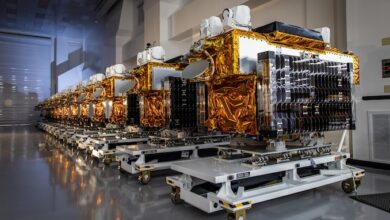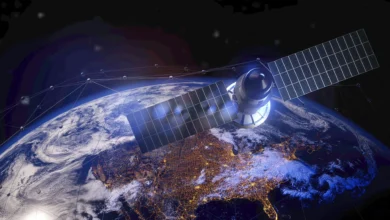


As the United States National Aeronautics and Space Administration (NASA) prepares for first ever lunar spaceport, engineers are developing a traffic control system called Gateway, to keep spacecraft moving safely and efficiently.
Within the next two decades, NASA’s planned Gateway could become humanity’s first lunar spaceport, serving Orion crew capsules, lunar landers, cargo vehicles, and astronauts traveling between Earth, the moon, and eventually farther into deep space.
Unlike an airport on Earth, Gateway will have no runways, taxiways, or gate announcements. Rather, spacecraft will move through an invisible network shaped by the gravity of Earth, the moon, and the surrounding region of space, where trajectories are governed by precise mathematical rules.
Managing that traffic will require its own form of orbital air traffic control.
Engineers from Texas A&M University, NASA’s Johnson Space Centre, and Purdue University, have developed algorithms and operating strategies for spacecraft waiting near Gateway and for managing multiple vehicles moving through the same orbital environment.
Their work provides mathematical guidelines and orbital “rules of the road” intended to help several spacecraft share this difficult region safely and predictably.
The findings, published in Acta Astronautica, examine how to balance fuel use with operational needs while lowering the risk of spacecraft collisions.
“The future of lunar exploration depends as much on the traffic management as it does on the rocket science,” said Dr. Diane Davis, associate professor of Space Engineering at the Texas A&M University College of Engineering, and an author of the study.
Gateway’s orbit creates a traffic challenge.
Establishing a sustained human presence near the moon will require more than simply reaching it. Spacecraft will also need an infrastructure that allows them to occupy and move through the same gravitational environment without interfering with one another.
For Gateway and the spacecraft visiting it, that environment centers on a Near Rectilinear Halo Orbit, or NRHO.
Gateway’s orbit NRHO is a nearly stable and highly elongated orbit around the moon that provides an uninterrupted line of sight for communications to Earth and requires little propellant to maintain, Davis said.
Gateway and nearby vehicles will nevertheless experience constantly changing gravitational pulls from both Earth and the moon as they travel along this elongated orbit.
The trajectory is also unlike any orbit previously used for crewed spacecraft. It brings Gateway to within 1,000 miles of the moon’s north pole before carrying it nearly 40,000 miles beyond the south pole.
The findings, published in Acta Astronautica, examine how to balance fuel use with operational needs while lowering the risk of spacecraft collisions.
A single station can remain on course with occasional thruster burns. The situation becomes more complicated when an Orion crew capsule, an uncrewed cargo vehicle, and a large lunar lander may all need to approach, dock, depart, or wait in the same region.
“Collisions and serious damages could happen. To ensure crew safety and mission success, effective traffic management in the NRHO is crucial,” Davis said.
One of the central ideas behind that traffic system is loitering, which means carefully maintaining a spacecraft in relation to a particular orbit or trajectory while it waits.